 道場 Degen Dojo
Framed Degens — Stories
47 framed fighters, each with a story written just for them.
Assassin Fuzen
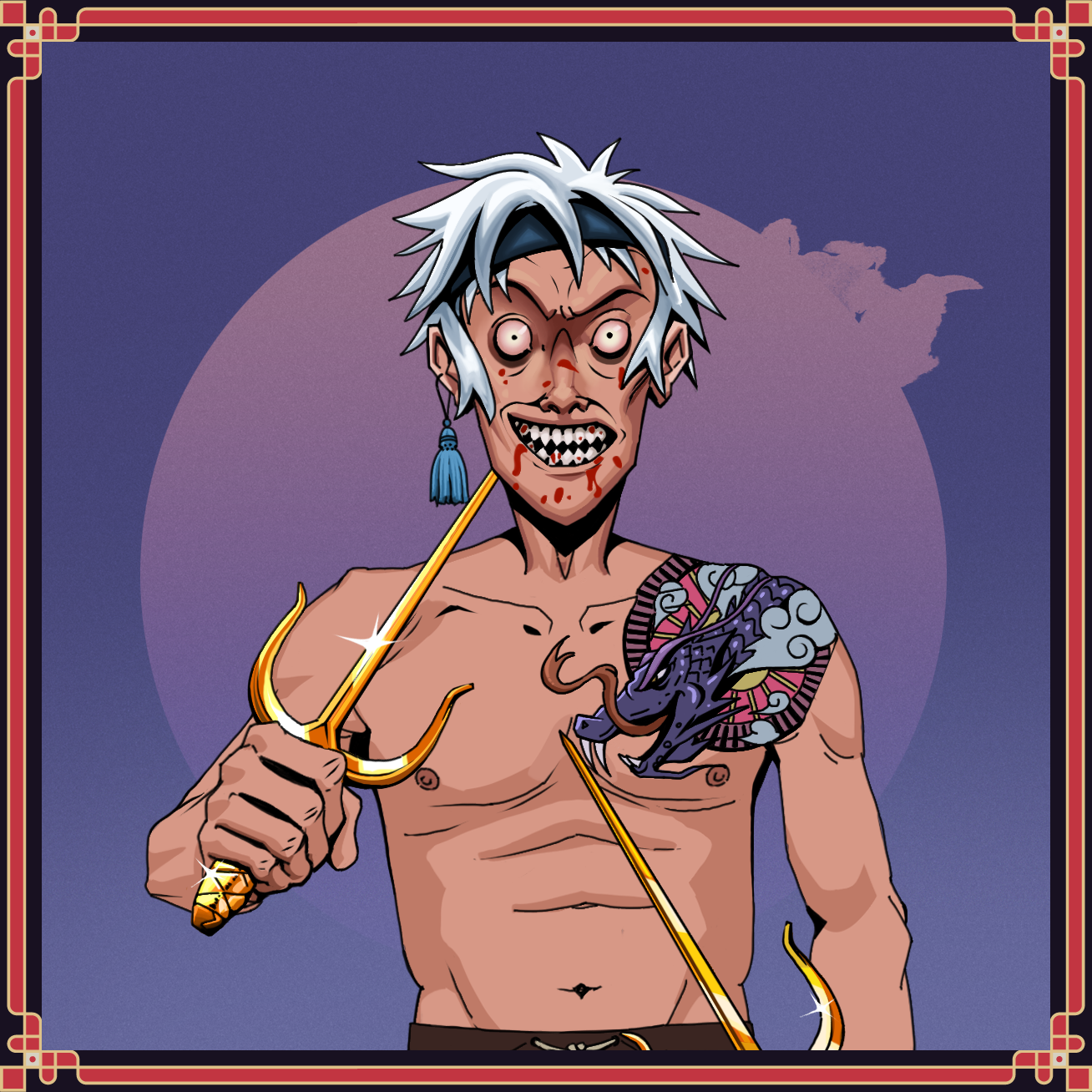
On the black sand of Fuzen's beach, the assassin who had never once left a job undone raised his blade against his own men, and the steel snapped as if it too had grown tired of him. He gathered the pieces with the same quiet patience he once brought to contracts, promising himself that this was simply an open ledger, not a failure. Some nights he sharpens what remains and calls it improvement; most nights he ends up wagering the hilt in a floor-level dice game and losing anyway. The old discipline waits for him like a target that will not stop breathing, and he keeps telling it soon, soon, the way a killer talks to a debt he has no intention of settling clean. There is unfinished business between Fuzen and the man he used to be, and neither one is in any hurry to close it.
Assassin Fuzen
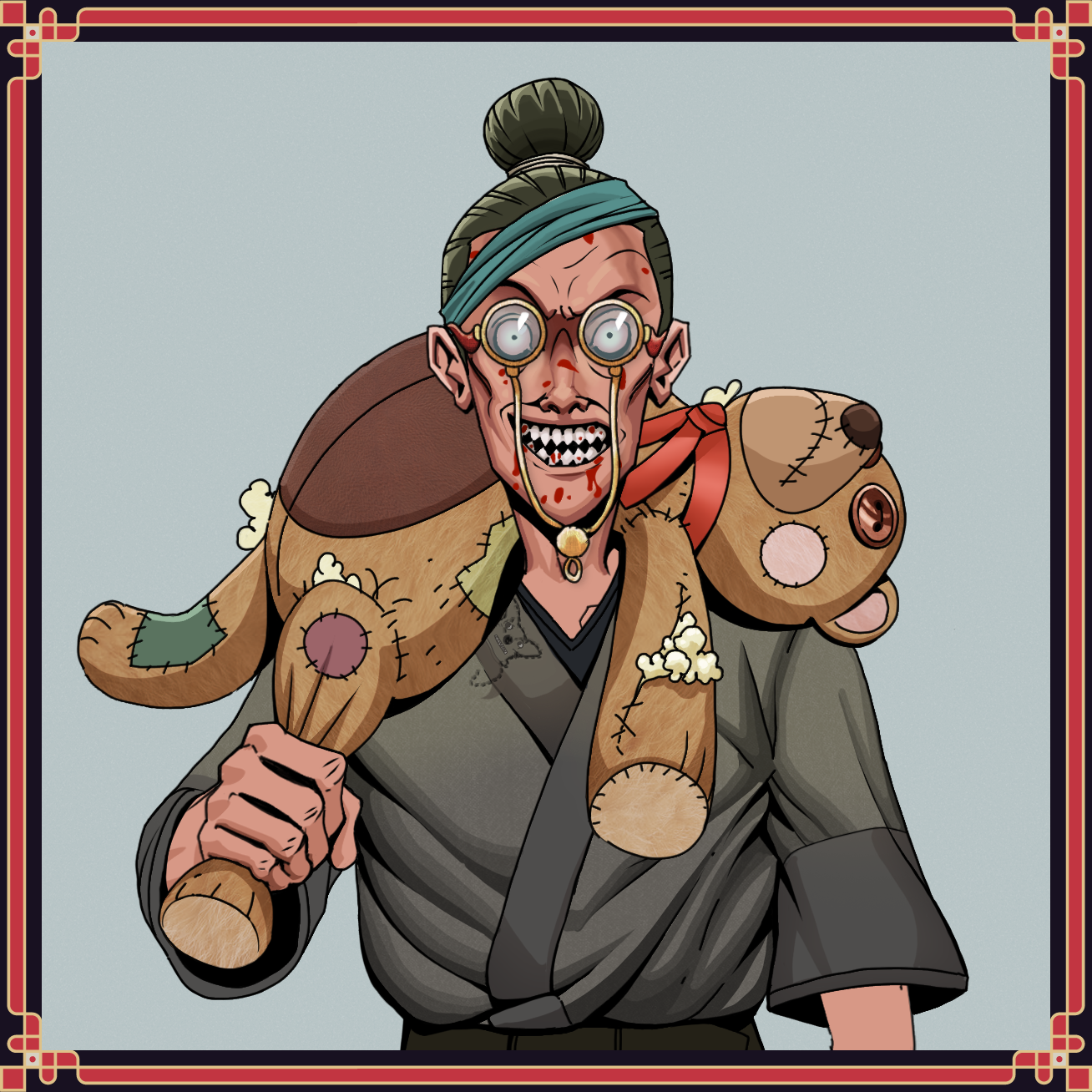
Fuzen once closed every contract he opened, a blade so quiet the dying never heard the sentence being read. Then peace arrived, and with nobody left to hunt, he took his patience to the izakaya, where he serenaded courtesans with borrowed songs and caught a disease that no clean strike could cut out of him. He tells himself the cure is discipline, that he will teach degens the old forms and reclaim the man he buried under sake and bad decisions, yet every lesson dissolves before the first bow is finished. The job is still open; Fuzen simply waits, dry and unbothered, for the day he finally gets around to killing his own worst habits.
Assassin Fuzen
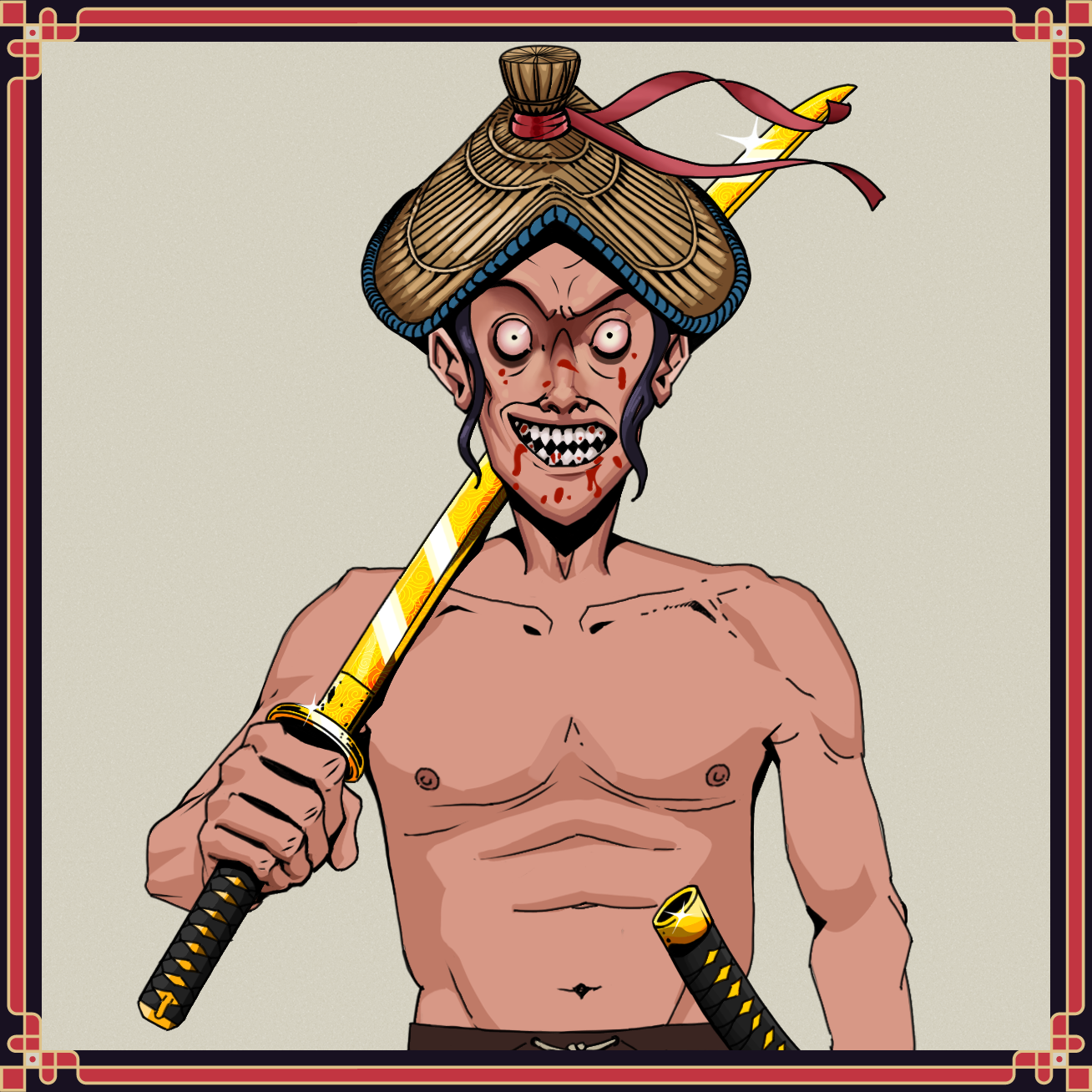
Fuzen had killed men for less than the sum he lost that night in the whorehouse, where Fred's snake struck fast and quiet, its venom draining his fortune before he could reach for a blade. He is patient about it, the way a contract is patient; he simply has not finished the job of getting even, and he never leaves a job unfinished. So he wanders now from teahouse to gambling den, asking anyone with grey in their beard what a broke assassin ought to do with his future, listening with the flat calm of a man taking notes for later. The old discipline whispers that he should meditate, save his coin, sharpen his edge; Fuzen nods, agrees completely, then apes the last of his silver on a dice throw that even a child could see was rigged. Somewhere out there Fred still breathes, and somewhere in Fuzen's ledger there is a line that has not yet been crossed out.
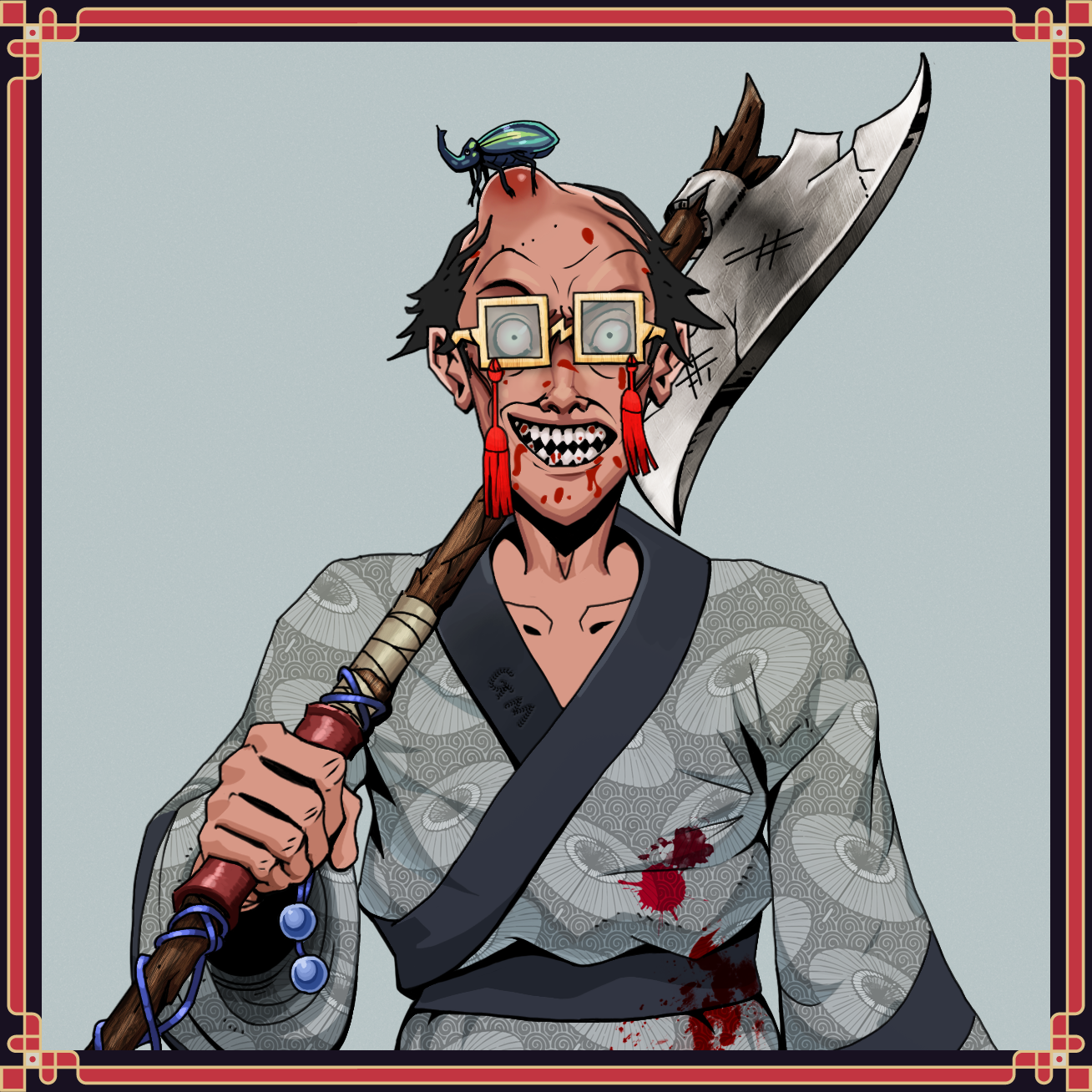
Assassin Fuzen
Under a bridge somewhere near the edge of memory, Fuzen took a contract nobody had offered, spat on a stranger, and walked away carrying a venereal disease he had not negotiated for. Once he closed every job clean, no loose ends, no witnesses, no regrets; now the only thing he cannot finish is his own recovery, which drags on slow and patient like a debt he keeps meaning to collect. He tells himself the discipline is still in there, buried under antibiotics and bad decisions, and each morning he swears this is the day he settles up with himself. It never quite closes. Fuzen waits, dry and unbothered, because the last mark he can't seem to take out is the man he used to be.
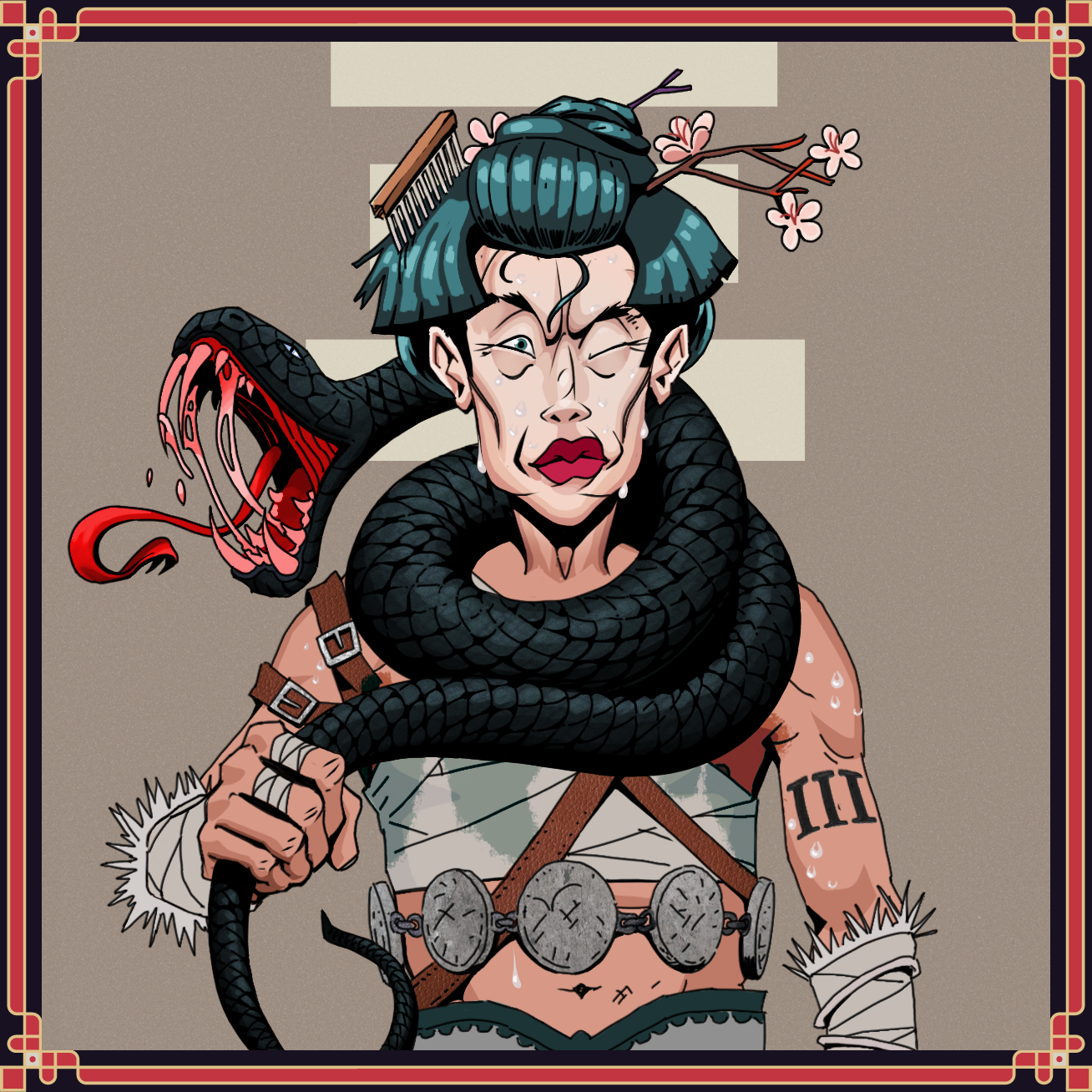
Charmer Fred
Once a decorated blade of the old provinces, Fred hung up his katana the day the wars went quiet and discovered that his sharpest weapon had always been his smile. Now he lingers at the Dojo gate in silk robes he cannot afford, leaning close to every wide-eyed hopeful, whispering that enlightenment costs only a modest entrance fee, payable to him, in full, and preferably now. The poor souls hand over their coin and their floor-priced dreams, only to learn weeks later that the Dojo was never gated, never priced, always free, and that the smiling old man had rugged them with nothing but charm. He tells himself each morning that today he will train instead of grift, that today he will honor the discipline he abandoned somewhere between the third sake and the fourth mark, and every day he ends up counting somebody else's money by the koi pond. And still, when he catches his own reflection in the water, he salutes it like a student greeting a master he can never quite become.
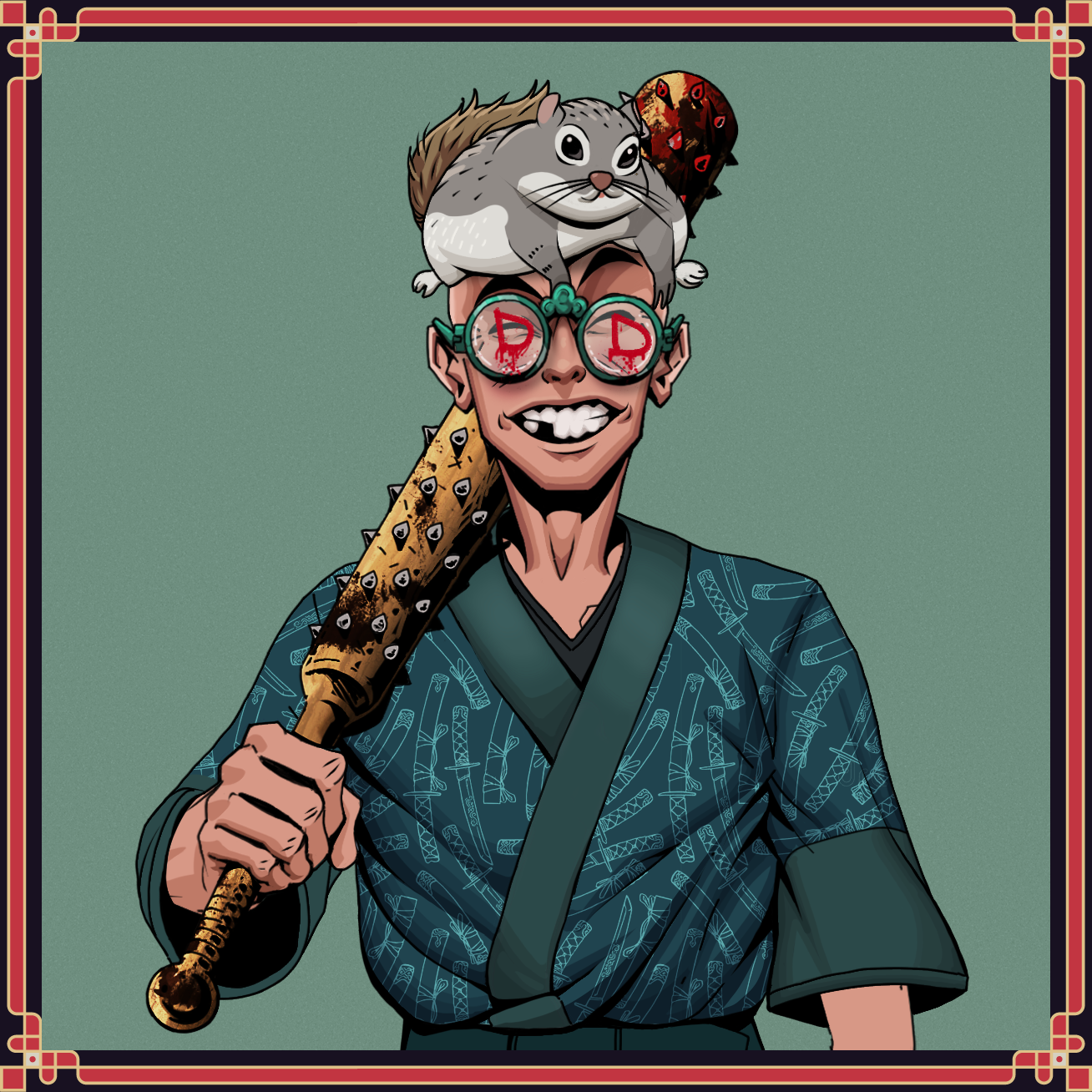
Cheery Haru
Before that afternoon on the tatami mats of the Kyoto dojo, Haru had always worn his grin like lacquered armor, the kind that never chipped no matter how hard the world swung. Then he talked with Edmundo, and something in that conversation cracked the floor beneath every plan he had, so now, he'll tell you with the widest smile you've ever seen, all his dreams have come true. He aped his last coin into a dream that rugged him overnight, and still he laughs, because laughing is cheaper than crying and hurts about the same. Some nights he sets his sword by the door and swears tomorrow he trains again, then dawn finds him three sake bottles deep and cheerfully insisting he's never felt better. The iron under the grin knows the truth, but Haru just winks and keeps the good news coming.
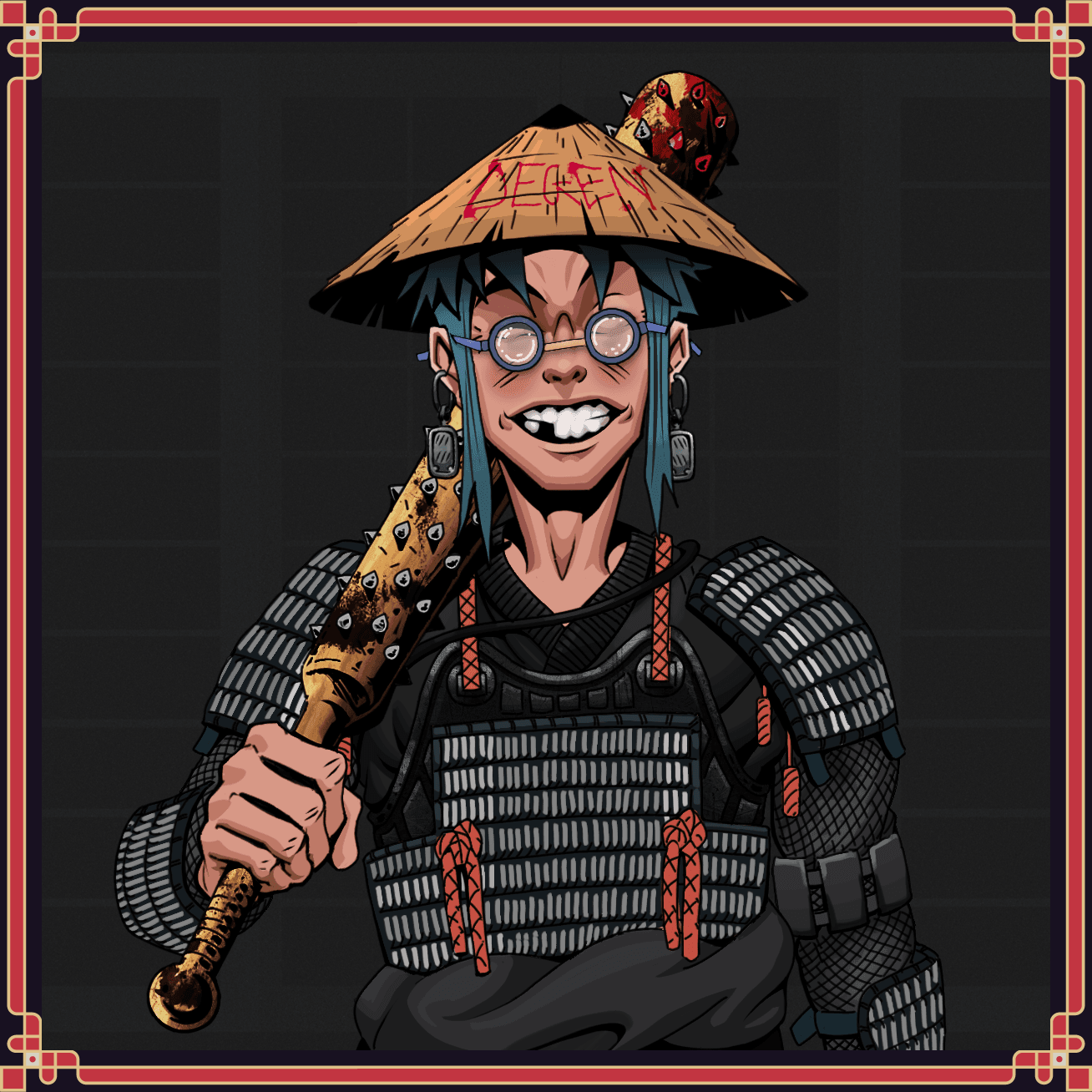
Cheery Haru
In the hush of his own quarters at Kōya, Haru once sat and arranged his thoughts like a general arranging troops, and folks swear his charisma doubled overnight, though the grin he wears now is less a discipline and more a shield bolted over something he does not talk about. He tells everyone he is chasing a quieter life, saying it so brightly and so often that nobody notices the cup he keeps refilling or the dice he keeps rolling long past the hour a real quiet man would sleep. Every dawn he vows to meditate, and every dawn the deck of cards finds his hands first, and he laughs about it because laughing is easier than admitting the war left a silence he cannot sit inside. Under the beaming face is iron, rusted a little, aching for the stillness he trained for and keeps aping instead of earning. So he beams, and he loses, and he beams again.
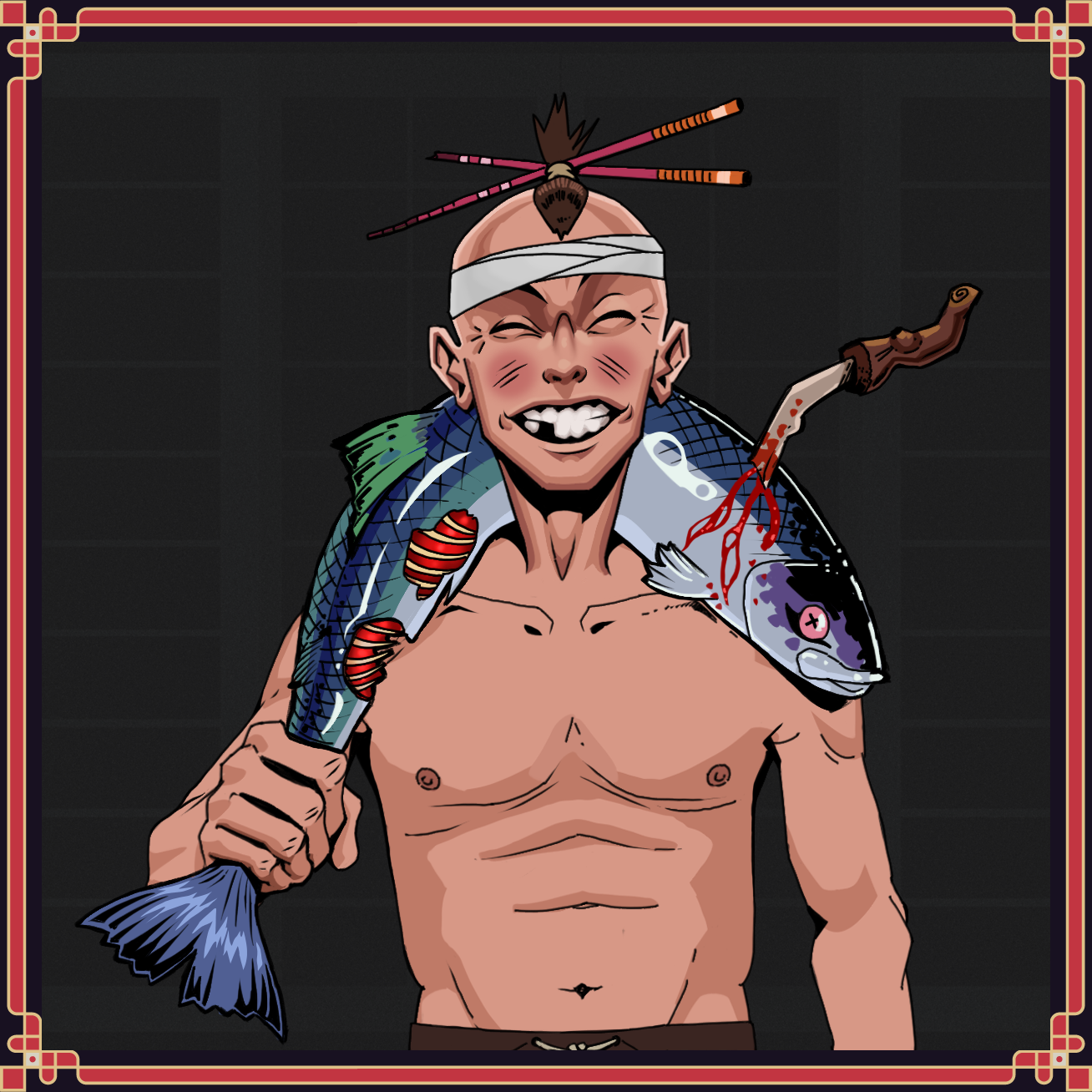
Cheery Haru
Once, in the whispering bamboo forest outside his lord's estate, Cheery Haru got a little too clever and impersonated his superior, cracking jokes in a borrowed voice until the words tumbled out too rashly and cost him everything he had trained for. He laughs about it now, of course, always laughing, that big bright grin bolted on like second armor while something colder holds it all together underneath. Truthfully he misses the simpler days, back when his whole duty was cleaning poop from the stables at dawn, a task so humble no rash tongue could ruin it. Every so often he swears he will find that quiet discipline again, then someone offers him a drink or a dice cup and he apes right back in, still beaming. Discipline keeps slipping through his fingers like river water, but hey, at least he goes down smiling.
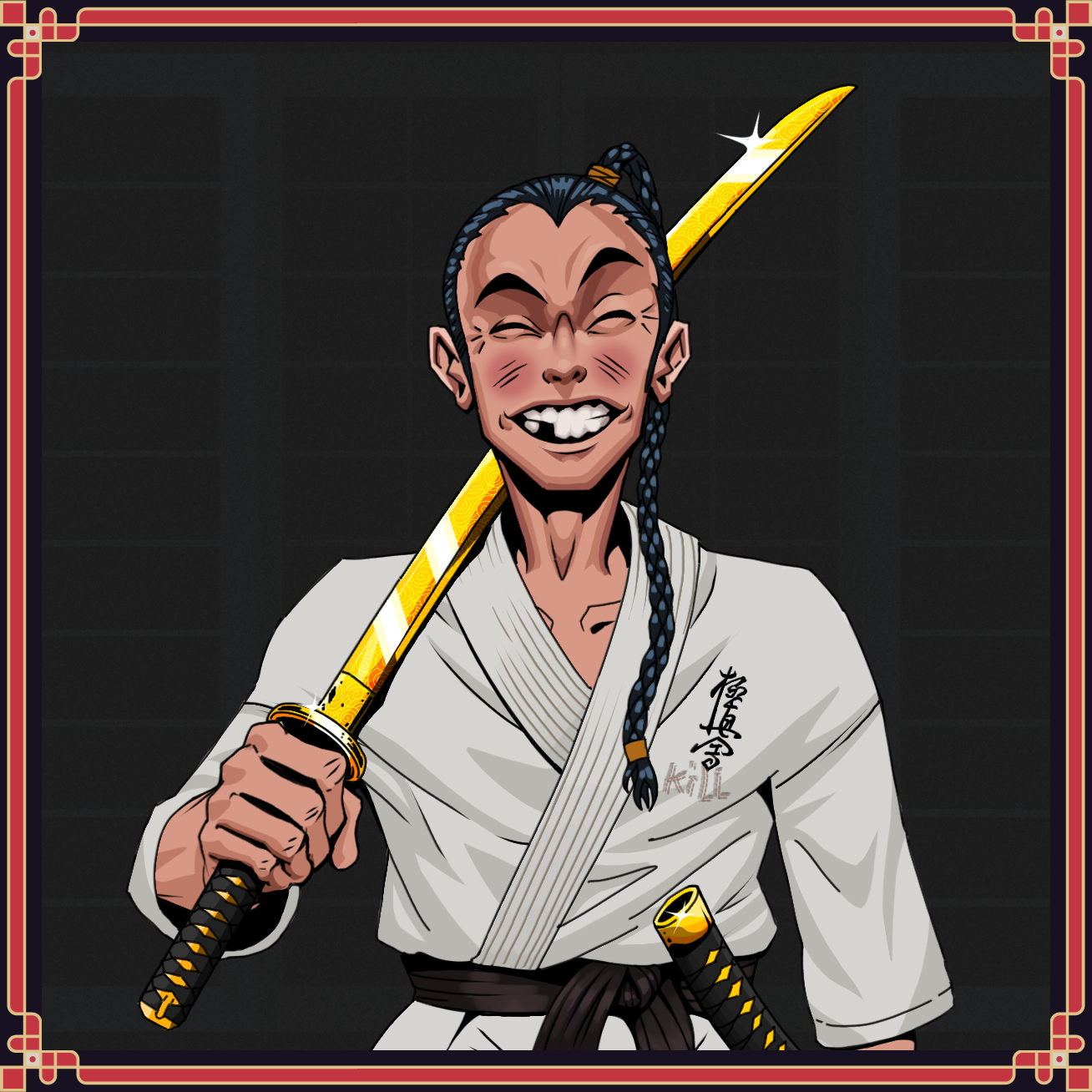
Cheery Haru
Everyone remembers the day at Mount Fuji when Haru stood on a frozen ridge and shouted challenges at a whole clan of ninjas, grinning wide even as one of them snapped his arm clean like a dry reed. He laughed it off, of course, told the shadows they had done him a favor since he never liked that arm much anyway, and that grin never once slipped no matter how the bone ached beneath it. Long before the vices, before the aped bets and the late-night chaos that swallowed his fighter's coin, Haru had been a proper samurai, and some quiet part of him still tries to march back into that old discipline every dawn. He fails by noon, every single time, usually because someone offers him a drink or a bad wager and he cannot bear to disappoint a friend. But he keeps smiling, that iron underneath holding the cheer up like scaffolding, a true Degen who decided long ago that hurting quietly beats admitting it out loud.
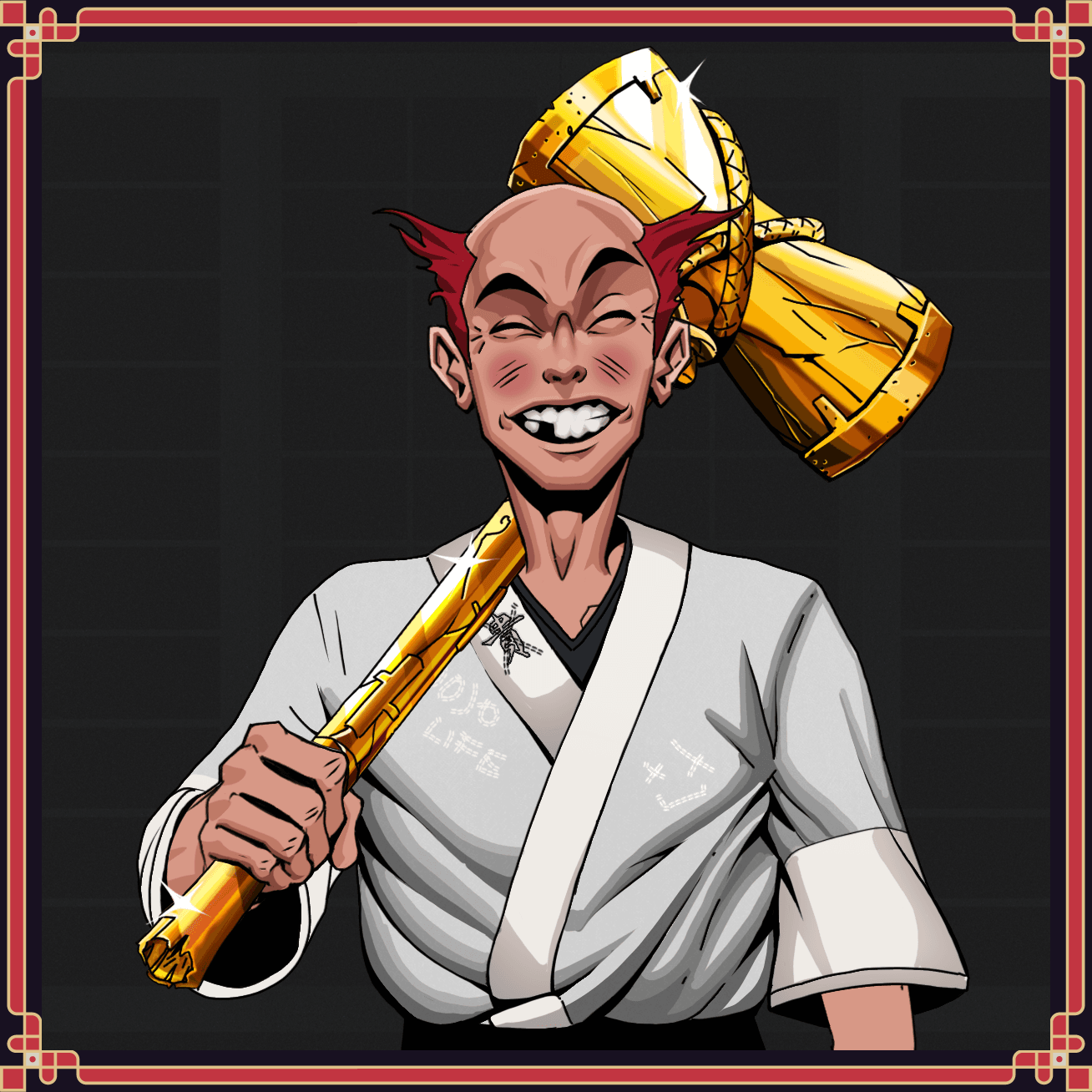
Cheery Haru
Once, Haru held his blade with the crisp certainty of a man who trusted tomorrow, back when the wars gave every dawn a purpose. Then the fighting ended, the coin ran dry, and he drifted into the perfumed rooms of the whorehouse where a wagging tongue earned free drinks and worse enemies, until one night his gossip found the wrong ear and a knife found his ribs. He laughs about it now, of course, flashing that famous grin as he says the scar just gives him more to chat about, and only the sharpest observer catches the flint behind his eyes. He swears every morning he will train, meditate, live like the samurai he was, and every morning he trades the wooden practice sword for another round and another rumor. Haru lives one day at a time, and he insists, brightly, always brightly, that this is the very best way to live.
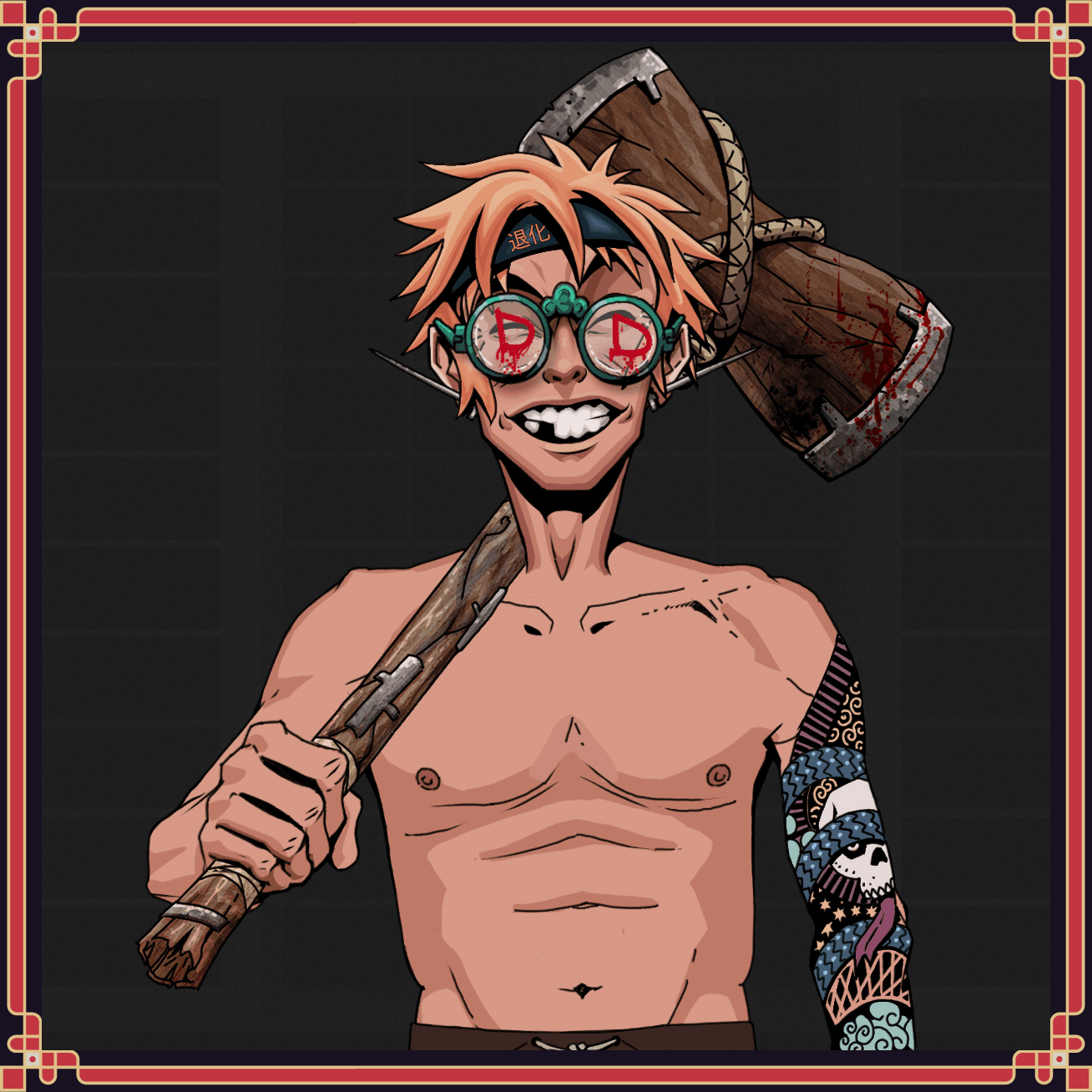
Cheery Haru
Everyone in the Degen Dojo still tells the story about the night Haru ate one too many mushrooms and started swinging at spirits only he could see, and how the elders decided his stones were more trouble than they were worth. He laughs the loudest at that tale, flashing a grin so wide you'd never guess it was load-bearing, because a samurai learns early that a smile can hold up a whole man when the discipline underneath has crumbled. He tried, bless him, to reclaim his old form, meditating at dawn and vowing to stay clean, only to be found by noon giggling at a caterpillar and calling it sensei. Ask him if he minds what he lost and he'll clap you on the back and declare himself the freest, lightest, proudest man in all the province. Underneath that beaming face is iron, and the iron aches, but Haru would rather die than let the grin slip.
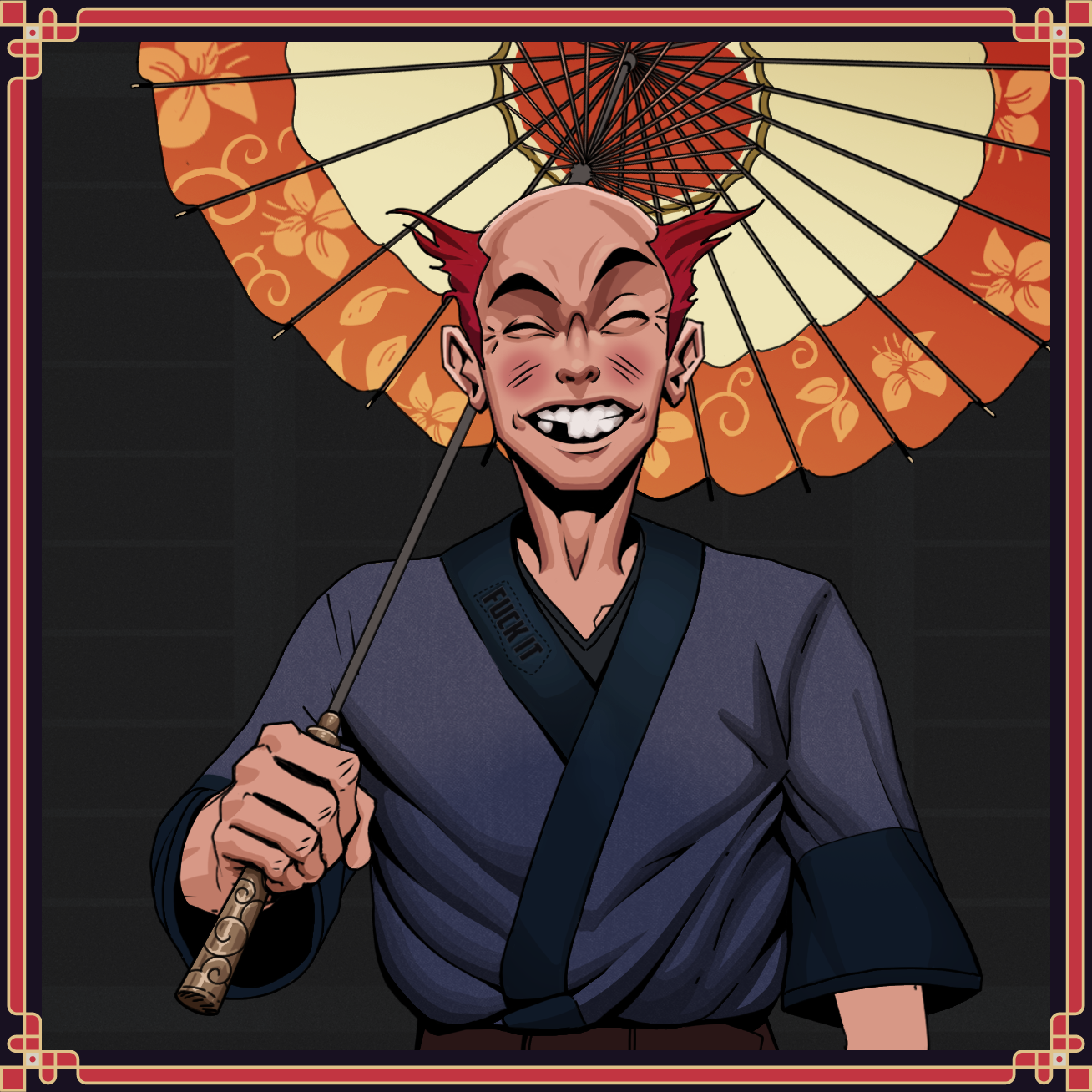
Cheery Haru
Before the grin, Cheery Haru ran a Yakuza crew with a smile so warm nobody noticed the iron behind it, and when the old wars fizzled out he decided greatness lived at the top of Mount Haku. He climbed it three times, chirping the whole way about focus and rebirth, only to celebrate each summit by aping into a flask and a fistful of weed until the discipline slid right back down the mountain without him. The Dojo kicked him out for it, and he laughed like it was the best news he'd gotten all year, because a laugh is just armor you can wear on your face. Deep down he still counts every push-up he swears he'll do tomorrow, grinning through the ache of a samurai who knows exactly how far he floored himself. Ask him how he's doing and he'll tell you he's never been better, which is the biggest lie he tells and the one he needs the most.
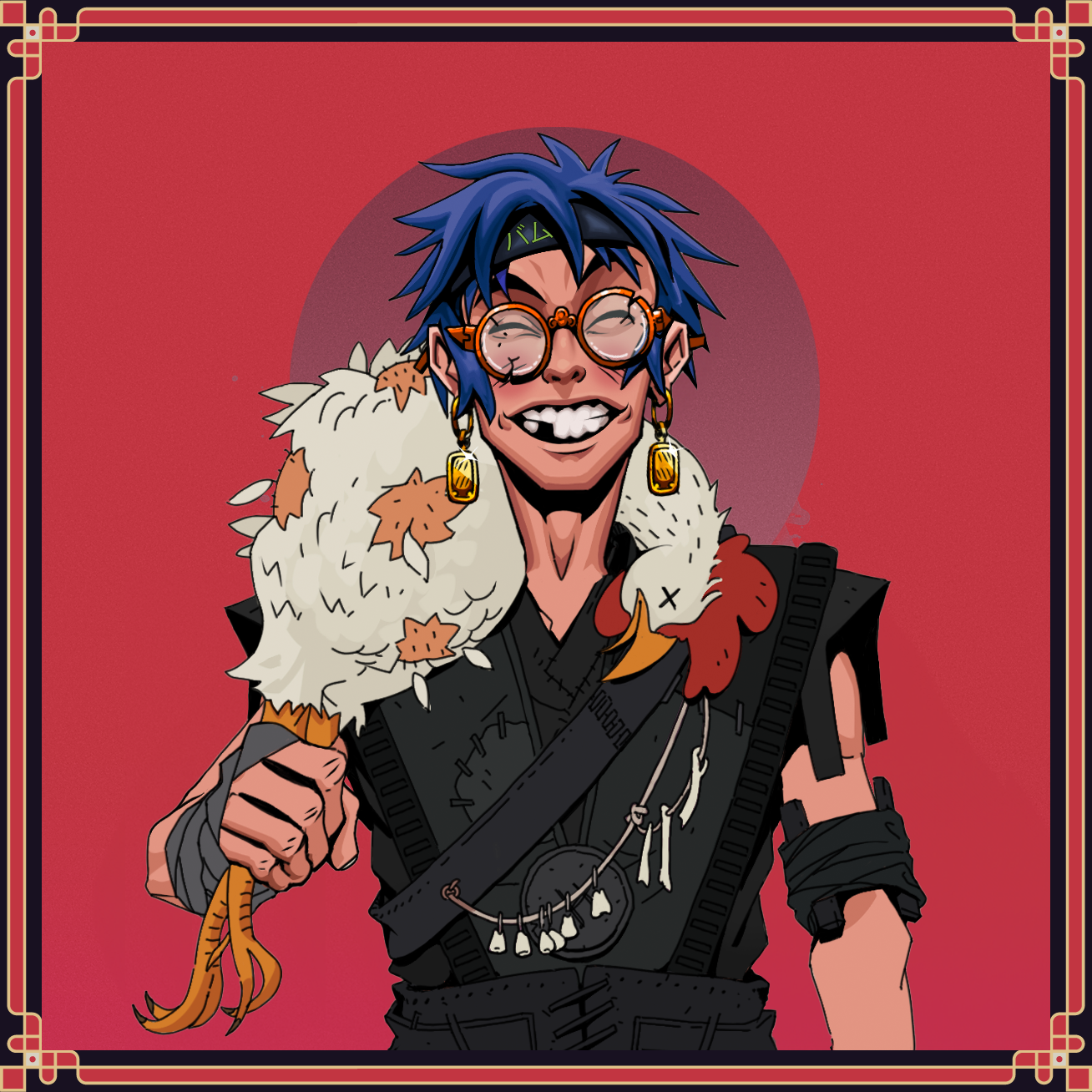
Cheery Haru
Everyone remembers the exact moment Haru's grin cracked, right there before the shoji doors of Kanazawa, where he crouched mid-sabotage against the very master who once taught him to bow before he learned to swing, and a stranger's hand landed somewhere no hand should ever land. He laughed, of course, because Haru always laughs, that sunny bark he wears like lacquered armor while the iron underneath rusts a little more each night at the sake table. Now he tells anyone who'll listen that he's going to write a book about it, a real memoir, best-seller energy, and he means it the way a degen means he'll stop apeing the floor after just one more mint. The truth is the pages stay blank because discipline keeps slipping through his fingers like spilled rice wine, and every dawn he swears he'll pick up the brush instead of the bottle. He never does, but oh how brightly he beams while promising he absolutely, positively will tomorrow.
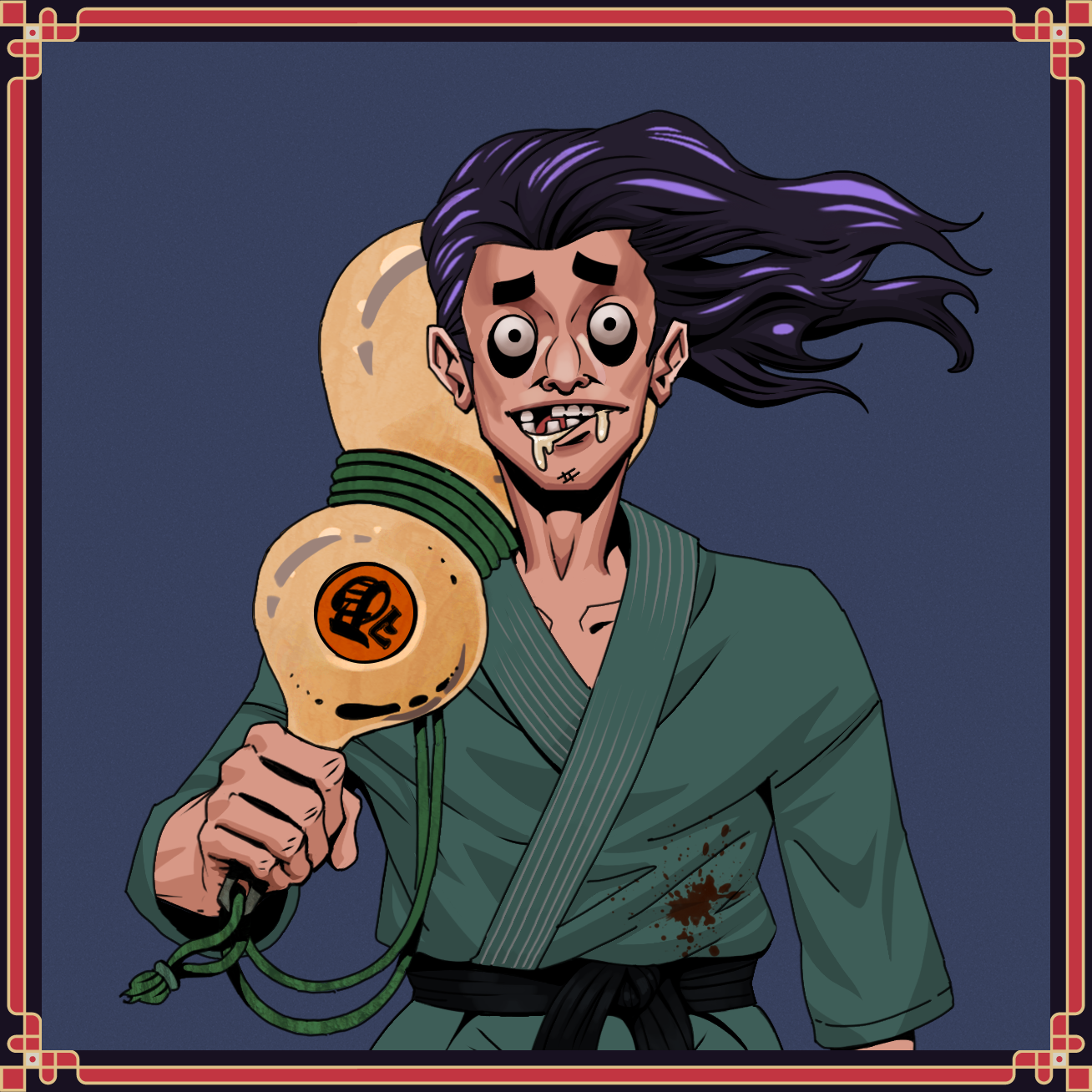
Drooling Azuma
Once Azuma stood ready for glory, blade gleaming, appetite honed to a warrior's edge, but the Nagasaki Lantern Festival smelled of frying skewers and easy money and he simply could not help himself. He aped his entire savings across every game the festival offered, dice and cards and one very suspicious cup-and-ball hustle, drooling all the while as the lanterns floated up and his coin floated away. He swears every dawn that today he trains, today he fasts, today he reclaims the discipline that made him, and by noon he is elbow-deep in dango, betting the last of his lunch on a coin flip he calls a sure thing. Loud, greedy, forever chasing one more big swing, he is a hunger that outlived its war and never once found the off switch.
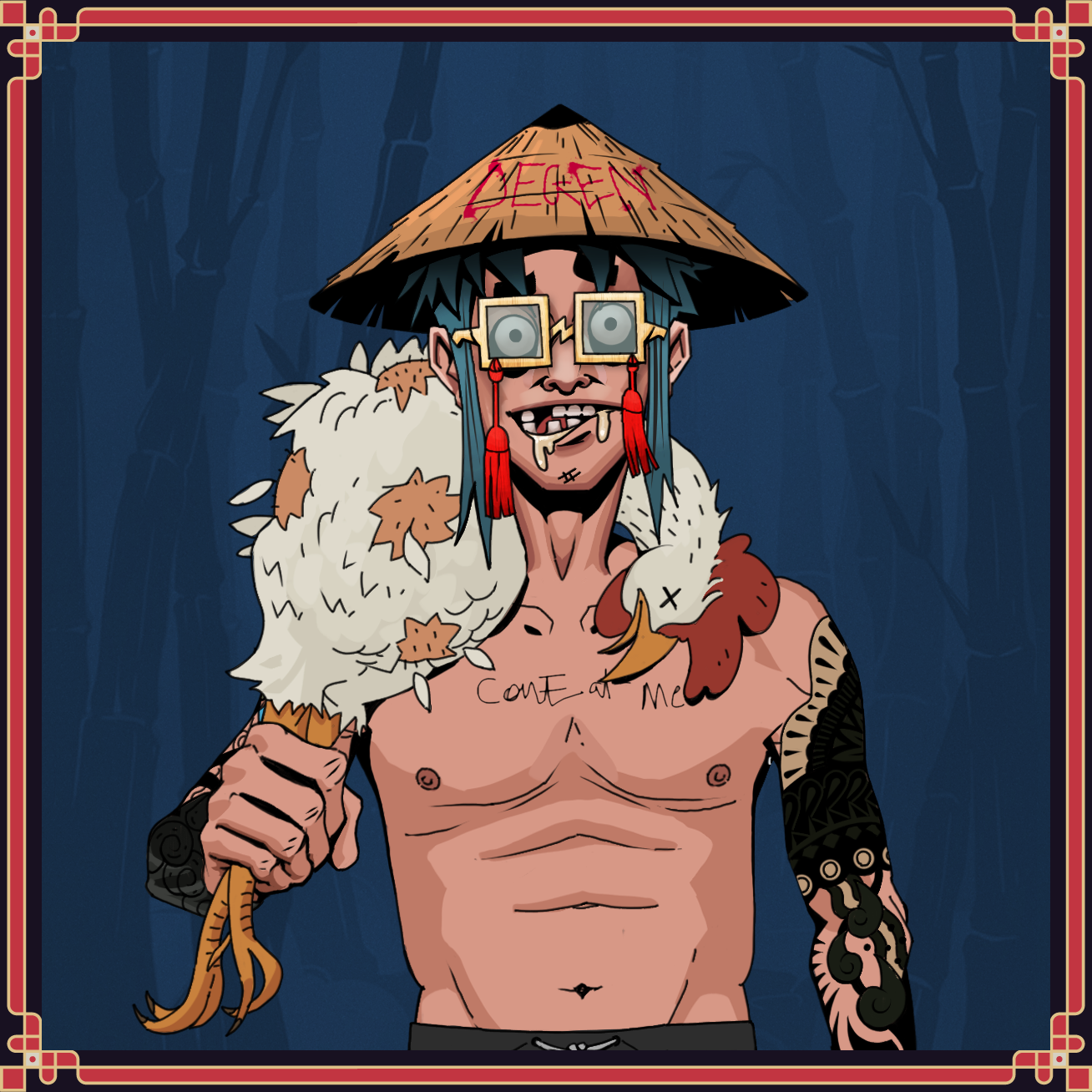
Drooling Azuma
Once Azuma commanded a battalion; now he commands only the buffet line, elbows out, drool already forming before the first plate lands. It was in the Arashiyama bamboo forest that his true undoing came, a violent bout of diarrhea that struck mid-charge and left his honor draped somewhere between the stalks, a moment he has loudly and repeatedly chosen to forget. He tells anyone within earshot that he could ape back into discipline any day now, then orders three more bowls and forgets what discipline even meant. The appetite that once fueled a warrior now feeds nothing but chaos, and gods above, does he feed it big. He swears the forest incident never happened, but the bamboo remembers, and so does everyone who was downwind.
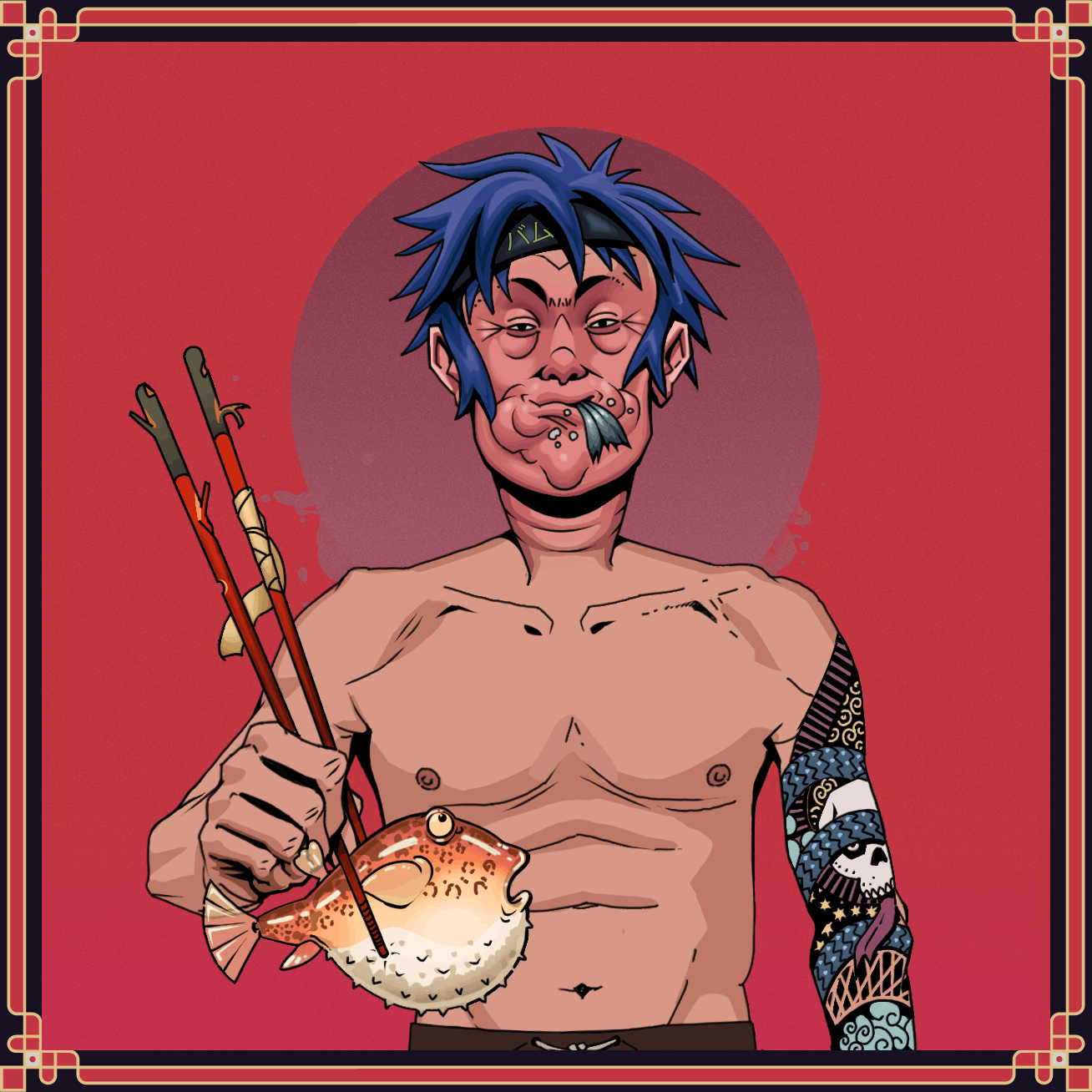
Fatty Bobsticks
In the garden of some forgotten daimyo, Fatty Bobsticks raised his blade against his own superior, and the man's parting strike took not his life but his hair, every last strand scattered across the moss like petals. He tells anyone who will listen that this was the moment he became truly free, his own man at last, no longer some footnote to a fatter, older shadow that keeps hovering at the edge of every story. He swears the baldness was a choice, a rebirth, a statement, and if you laugh he will remind you loudly that a scalp this smooth catches the wind and makes a warrior faster. The truth is he has tried three times to return to the dojo and reclaim the old discipline, and three times he wandered out instead with a fistful of dice and a head full of grand plans that floored by dawn. Freedom, he insists, tilting that gleaming dome toward the sun, was always the point, and nobody, least of all the ghost he argues with nightly, will convince him otherwise.
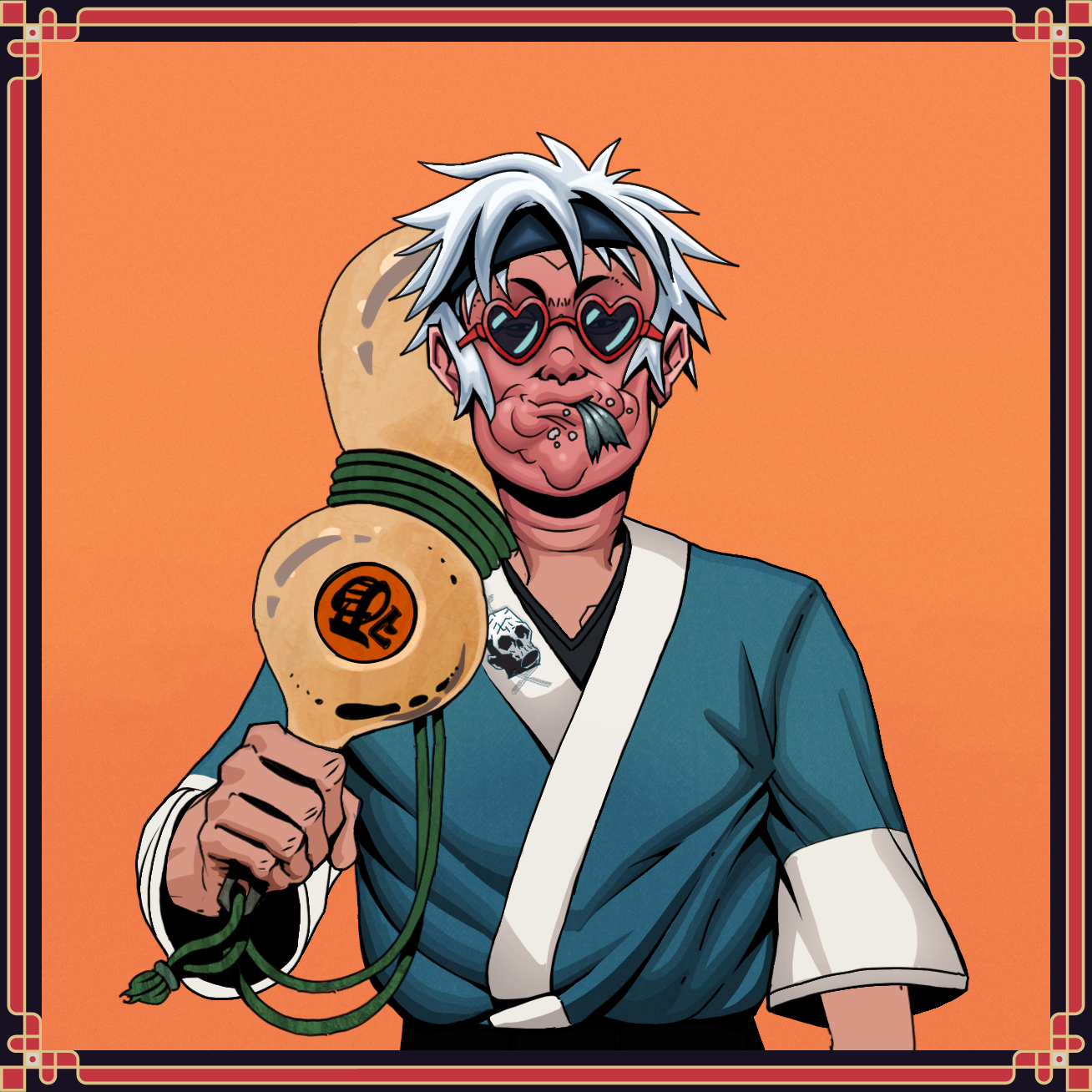
Fatty Bobsticks
Fatty Bobsticks will remind anyone within earshot that he is NOT his father, that Fat Bob's legend is a burden he never asked to inherit, and that his sword arm is, if anything, superior. And yet the whole valley still whispers about the night he lost his nipple staring down Oleg in his own bed, a duel that ended before it began because Fatty froze like a man who had aped his entire discipline into a single bad stare. He wears the shame like a second belt, tighter than the first, ordering another round to prove he is above such things and then weeping quietly into it when nobody is boasting back. Every dawn he swears to reclaim the honor his old master drilled into him, cracks his knuckles, unsheathes the blade, and by noon has traded morning drills for dice and a fresh bandage. The samurai he was meant to become still lives somewhere behind that lopsided chest, glaring out through Fat Bob's shadow, insisting he is his own man even as the shadow keeps winning.
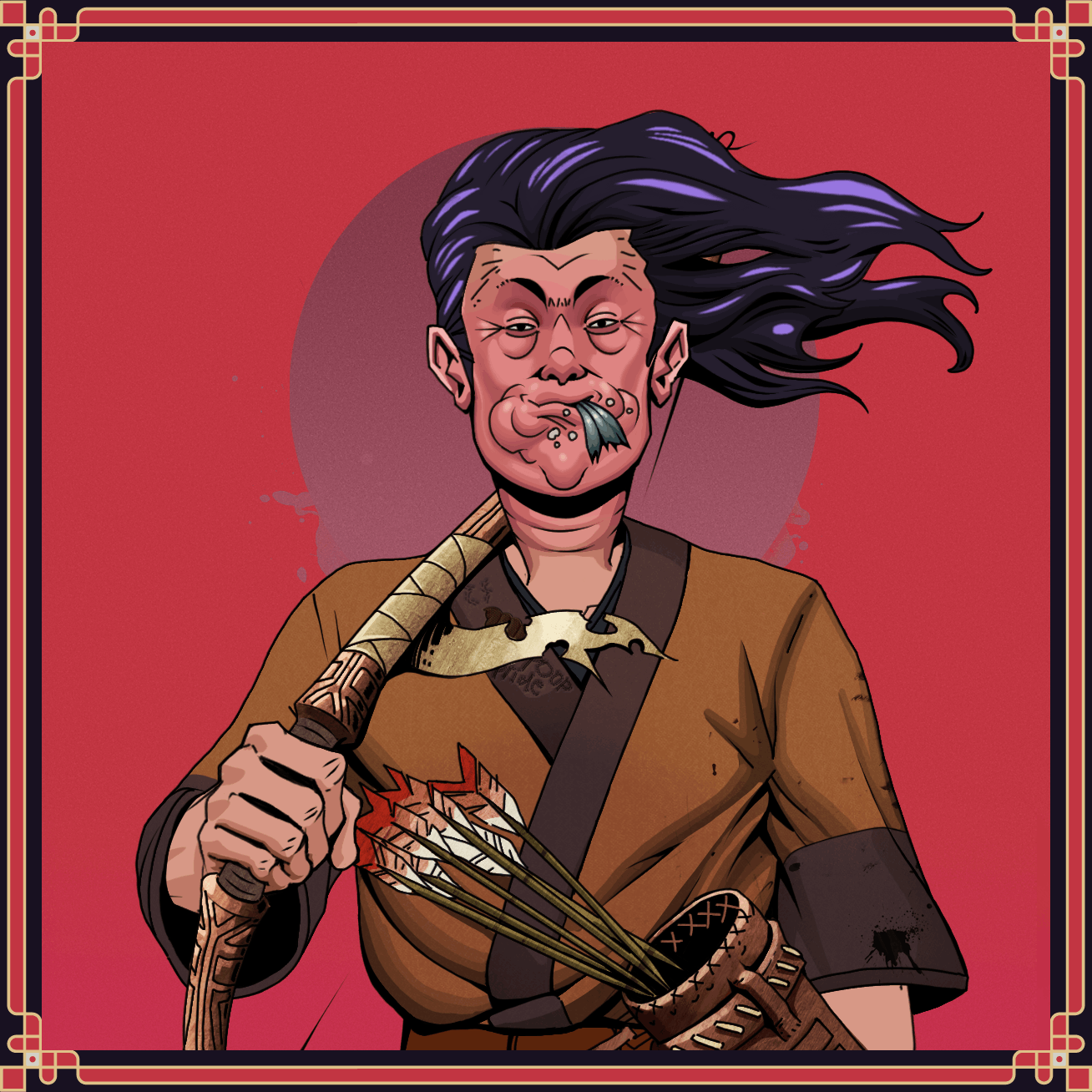
Fatty Bobsticks
Fatty Bobsticks will tell you, loudly and unprompted, that he is nothing like Fat Bob, that he is his own man, thicker of arm and sharper of blade, though nobody actually asked. Once a sworn retainer with a spine like a temple beam, he now spends his days insisting the war made him soft and the peace made him softer, mostly through the medium of weed and losing bets. On a hike up Mount Hotaka he got swarmed by a pack of giggling courtesans who complimented his cheeks and lifted his prized earring clean off his lobe, and he claims he let them, because a real master chooses when to be robbed. He swore that very evening to reclaim his old discipline by meditating at dawn, then slept through dawn, noon, and most of the following argument he was having with a bush. Now he is retreating to the jungle, chest puffed, vowing that this time the shadow of his old self will not follow, which of course it does, snickering the whole way.
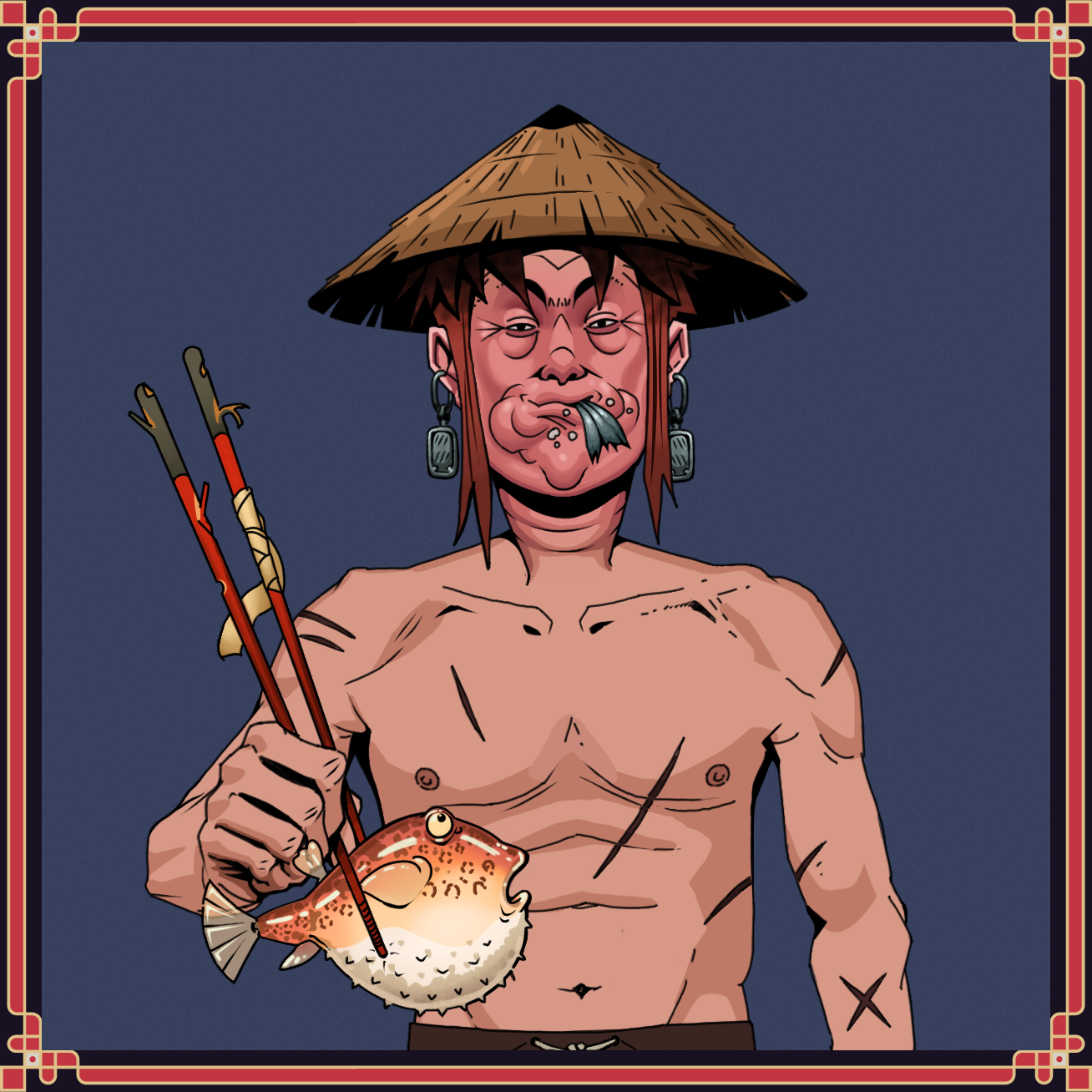
Fatty Bobsticks
Everyone insists on calling him Fat Bob's boy, and Fatty Bobsticks would like the record to show that he is his own man, thank you, with his own sword and his own considerable gut. It all went sideways at Mount Fuji, where he cornered The Degen Scholar expecting praise and instead got a long, quiet question about what he had actually done with his life, a question that hollowed out his nerve like a gutted koi. He tried to reclaim his old samurai steel that very evening and mostly reclaimed a jug of sake and a losing streak at cards, which he defends as a strategic retreat. Still, he thumps his chest and swears the better days are coming, that he will out-fight the shadow of every Bob before him. For now he practices his stances in the mirror, wobbles, and blames the mirror.
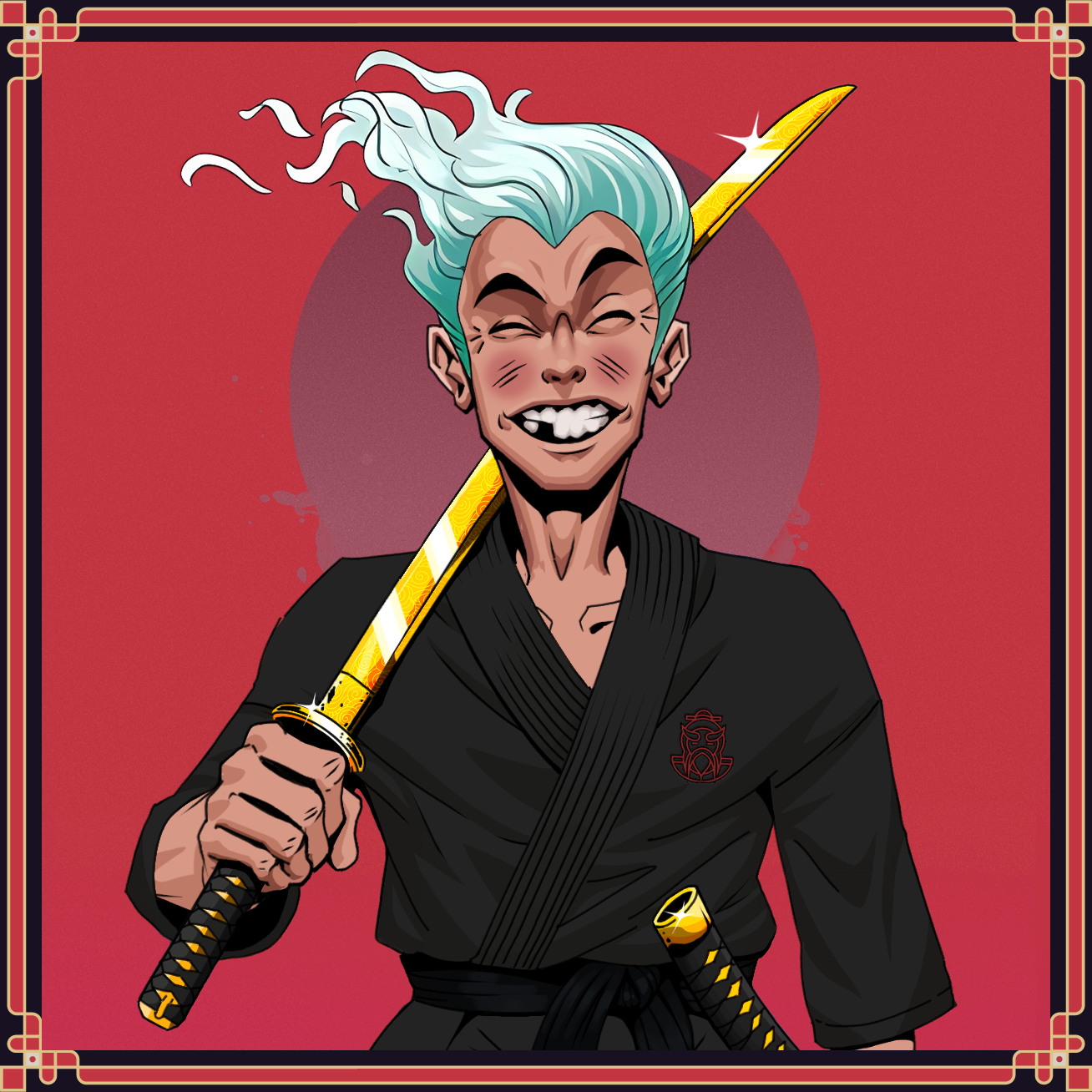
FiL
At sunset in a smoky gambling den, FiL wagered his whole family fortune on a single throw, and when the dice landed wrong a man ended up dead beneath his blade, though he still swears it happened while he was smiling. He tells the story now like a joke that got out of hand, grin bright as a lantern, insisting it made him a more humble person even as his hands remember the old samurai steadiness he keeps trying to fake. Every dawn he vows to quit the tables and reclaim his discipline; every dusk he is back, chips stacked, laughing too loud at his own cheerful lies. Humility, he claims, is just knowing you will lose and betting anyway. Somewhere under all that grin there is iron that never forgot the weight of what it cost him.
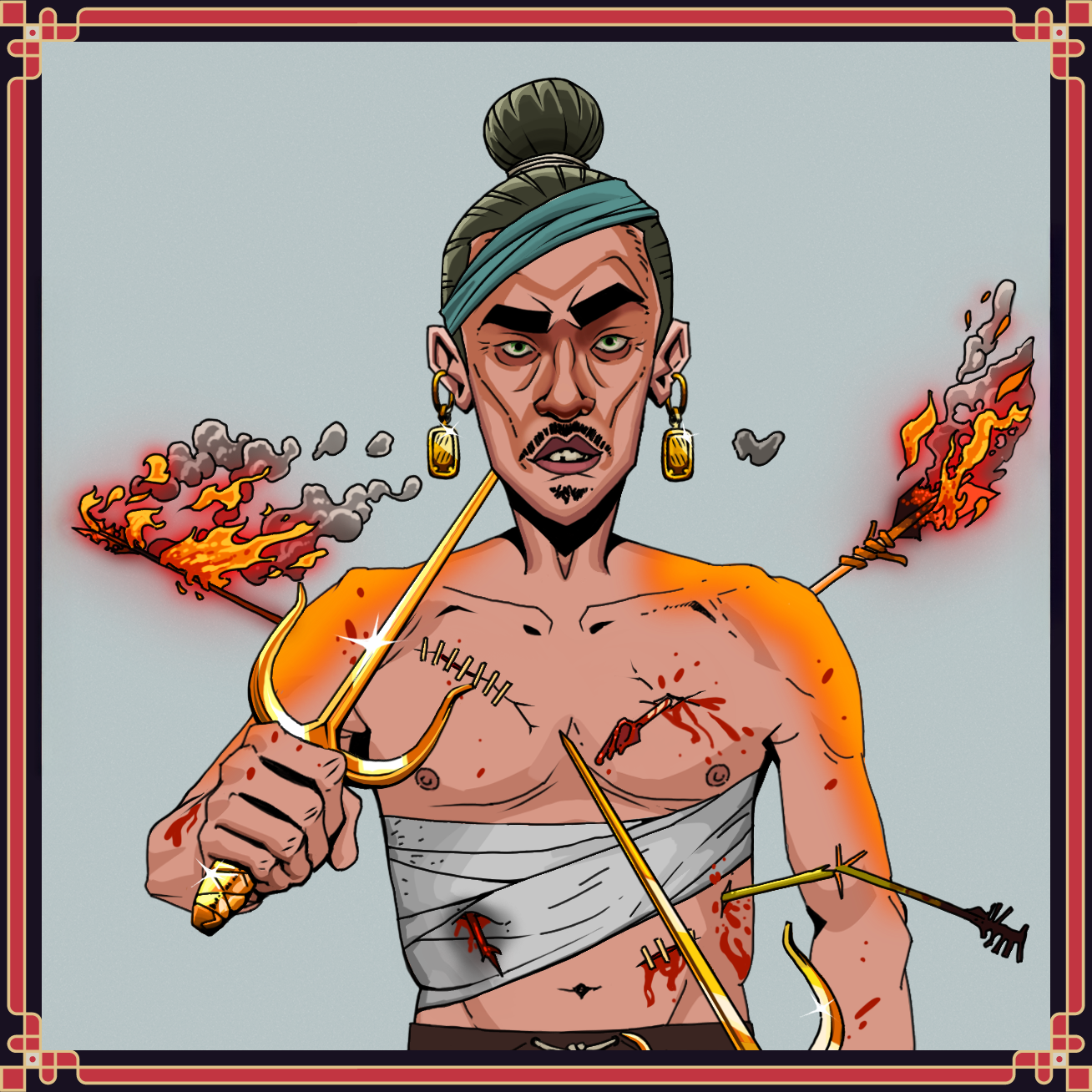
Gloomy Masumi
On a high moon evening in a quiet corner of Kyoto, Masumi looked his oldest friend in the eye and calmly listed every secret he knew, then named his price. He became a legend for it, though he would tell you plainly that legends are just the stories people repeat until the shame wears smooth. He remembers the sword he once carried and the vows that came with it, and he knows, with the flat certainty of a man reading a receipt, that he can do better. He tries. He fails. The failing is honest too, which is the only part he still respects about himself.
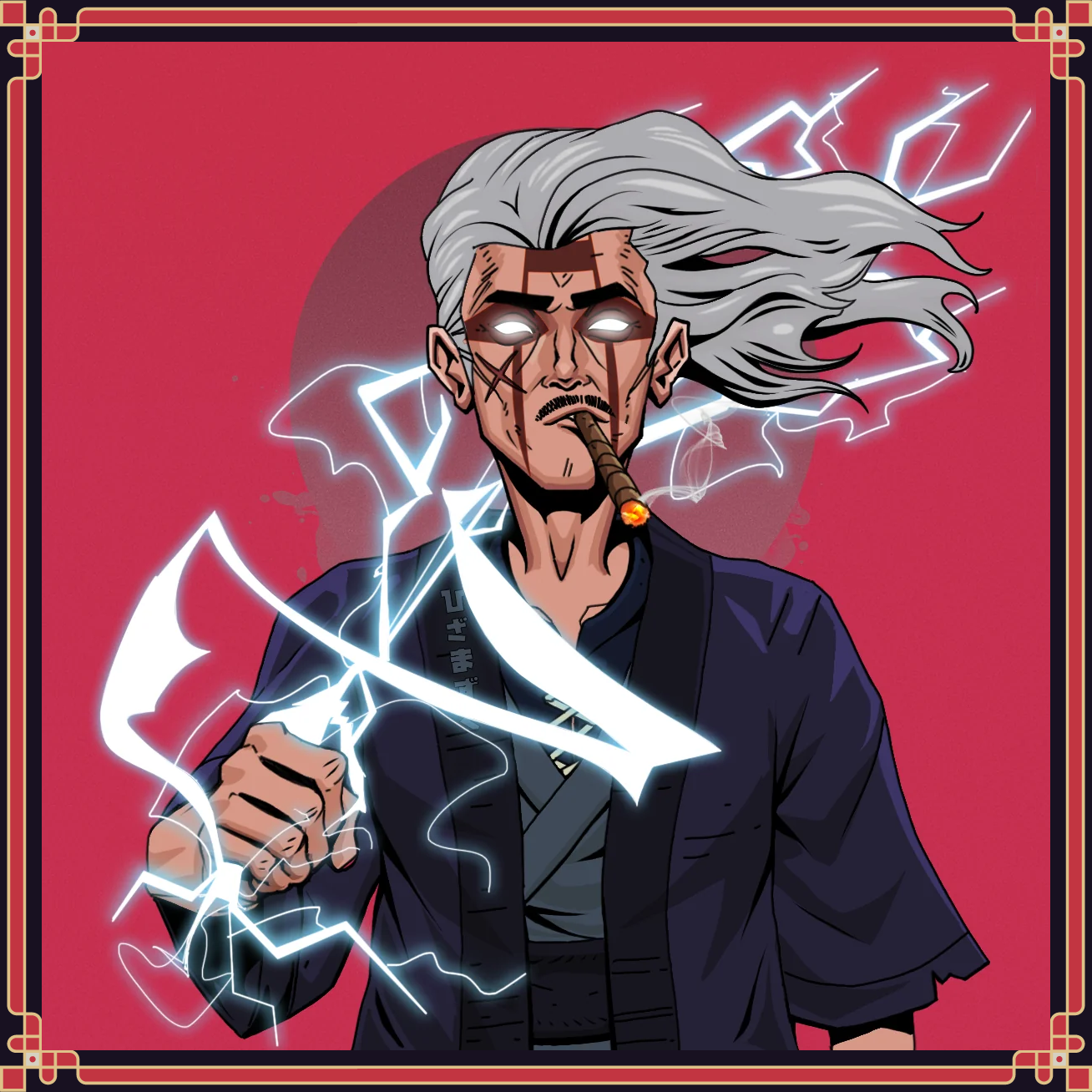
God Of Lightning
There was a season when the God Of Lightning behaved badly, real badly, betraying his own kin out in the cold like a man who mistook thunder for wisdom. He drifted after that, slow as smoke curling off a lantern, letting the weed and the losses stack up while he told himself he was just observing the flow of the universe, brother. Now he is writing the Degen Handbook, one deadpan verse at a time, promising it will restore the discipline he traded away, though most chapters trail off into a haze and a half-finished thought about the floor price. He swears the next page will strike like lightning; it mostly just flickers, and he nods at it anyway like it meant to. Balance is coming, he says, exhaling, and everyone pretends to believe the storm has a plan.
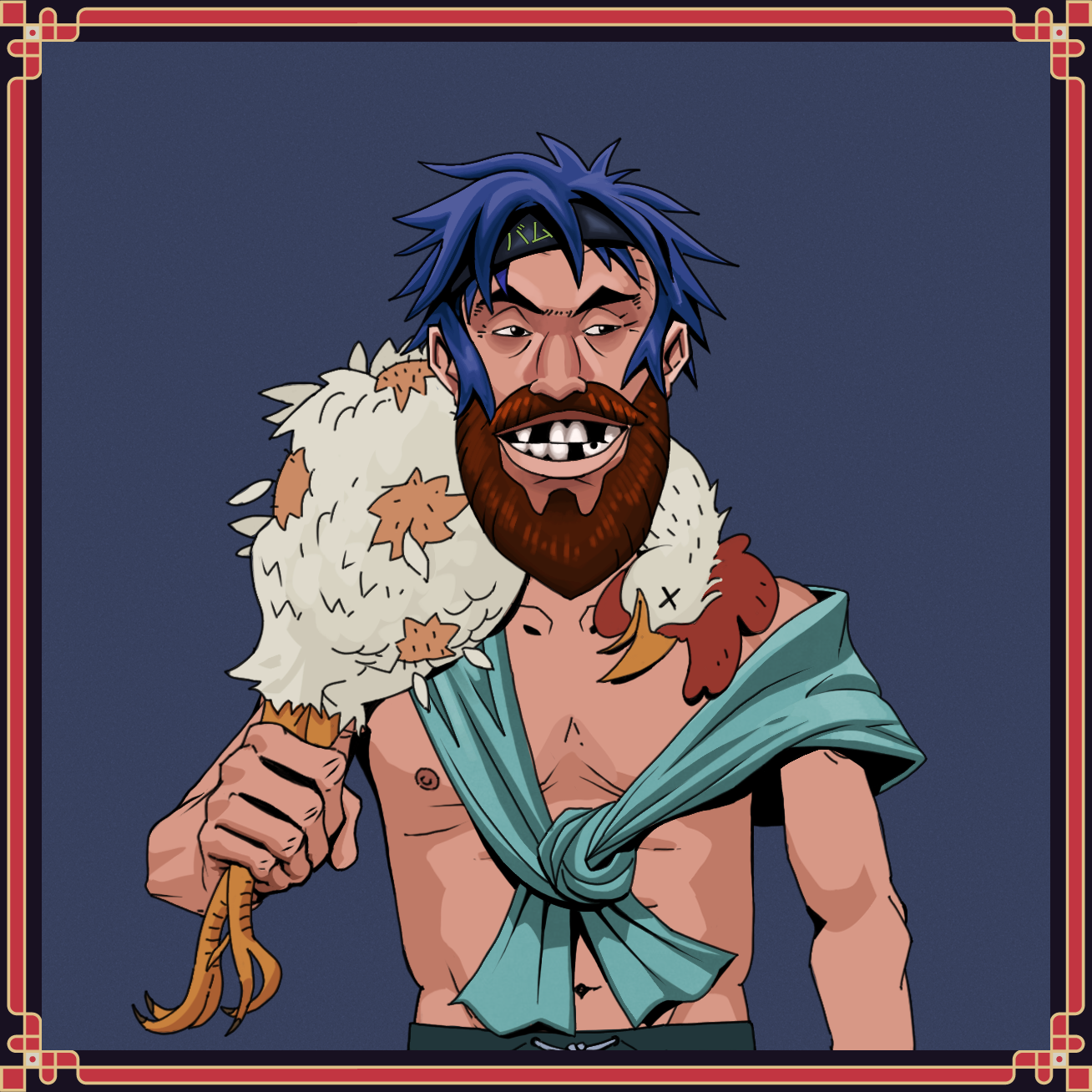
Igor The Bear
Igor the Bear went to the Nagayu onsen to clear his mind, the way an old samurai once cleared his blade before dawn, sinking his enormous frame into the steam until the water nearly climbed over the rim. Somewhere in that heat his dreams shattered, quietly, like ice giving way under a slow thaw, and he sat there a long while saying nothing at all. He came back down the mountain heavier than he left, though not from the water, and when he finally reached for the discipline he had lost he found his hands too slow and his gut too fond of sake to grip it. Still, the Dojo watched this mountain of a man refuse to fall, and they gave him their respect, because a bear does not start easily but once he moves, nothing on earth can stop him. He grumbled his thanks, dried off, and aped into another questionable bet by nightfall.
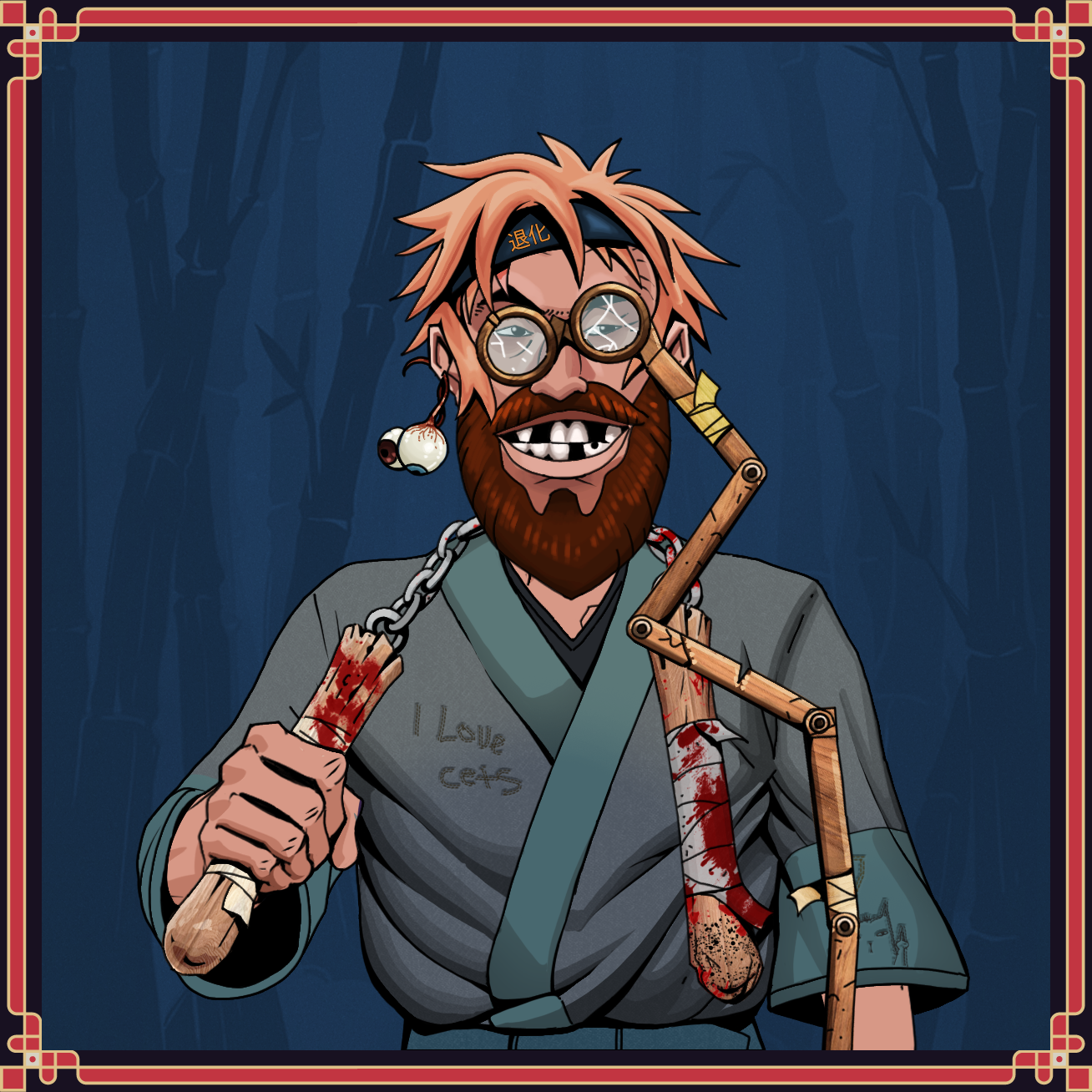
Igor The Bear
Igor The Bear was ambitious once, back when he had blades to sharpen and a name to make, before the day he stood in the bamboo forest and stared down Oleg. Whatever happened in those green shadows never made it into words, but Igor came out slower, heavier, a mountain that had forgotten how to walk uphill. Now he sits and drinks and lets the weed do the moving for him, and every so often, between long silences, he mutters about what could have been, then laughs low because dwelling never budged a bear an inch. He keeps telling himself tomorrow is the day he trains again, tightens up, gets back the edge; tomorrow arrives, finds him exactly where it left him, and quietly apes into the next round with him. Once Igor decides to move, though, nothing on this earth stops him, which is precisely why he so rarely decides.
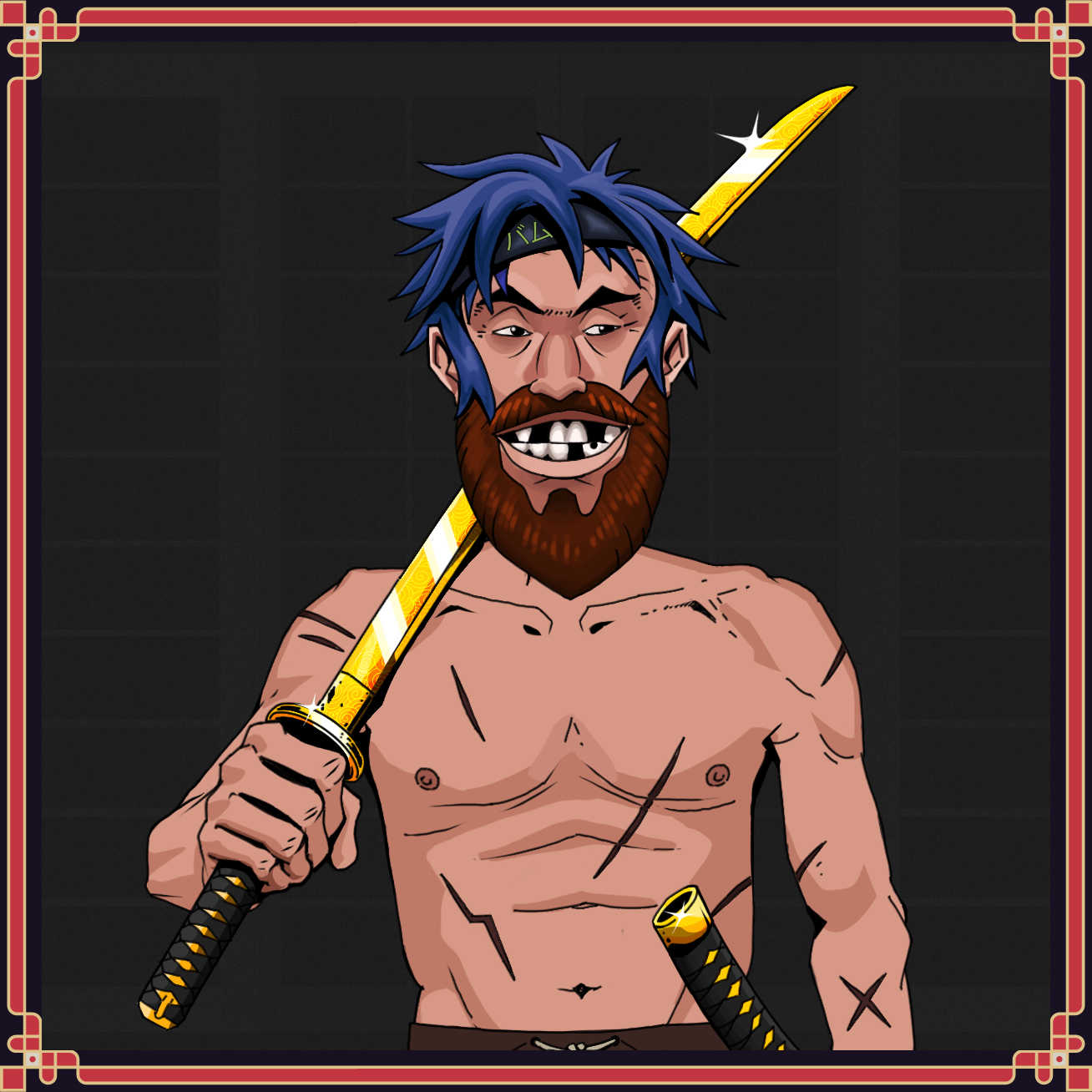
Igor The Bear
Igor The Bear once stood like a mountain in the dojos of Nagoya, a man so heavy with muscle and purpose that opponents felt him coming before they saw him. He fell asleep dreaming of glory, the kind of glory that comes slow to big men and never leaves once it arrives, and while he slept some quick-fingered coward lifted every coin he owned, leaving the great bear rugged and snoring in an alley. He woke poorer and slower, and he has been recovering ever since, one grudging step at a time, muttering that discipline is a boulder and he is the fool trying to roll it uphill. He tells himself he will quit the drinking tomorrow, then aped his last few coins into a card game and lost those too, which somehow bothered him less than it should. Do not mistake the slowness for weakness; once Igor finally starts moving toward what he lost, there is nothing on this earth that can stop him.
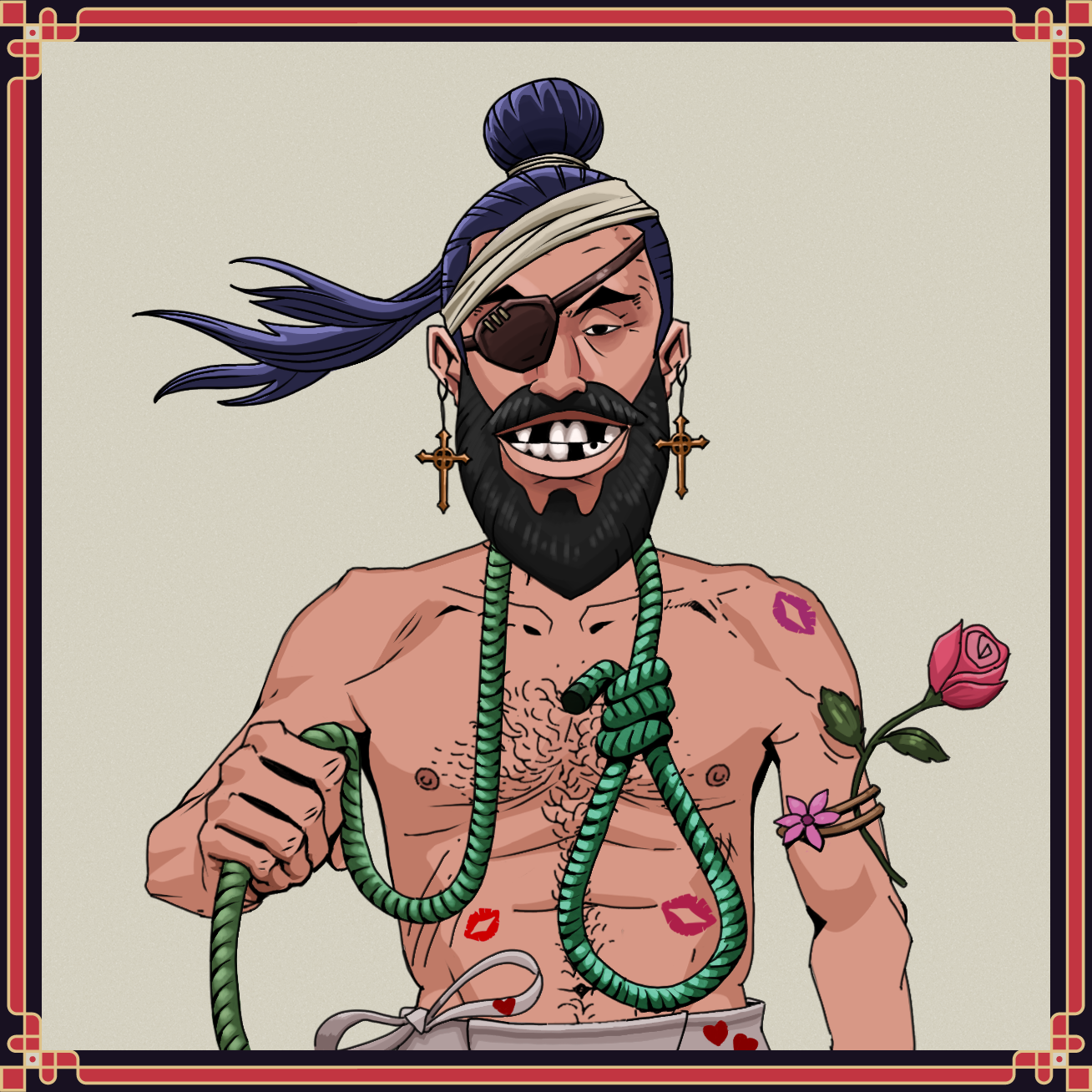
Igor The Veteran
Before the streets of Ikari swallowed him, Igor was a great man, a blade whose name settled arguments and quieted rooms. Something broke loose in those brawls, some hinge of discipline he never bothered to name, and he stopped bothering to name much of anything after. Now he sells himself on those same streets, trading whatever's left for whatever numbs, and every dawn he swears he'll drill the forms again before the bottle finds his hand first. He earned the title Veteran and he will not tell you how. The room goes still when he speaks, which is rare, and rarer still is the day he wins the small war against himself.
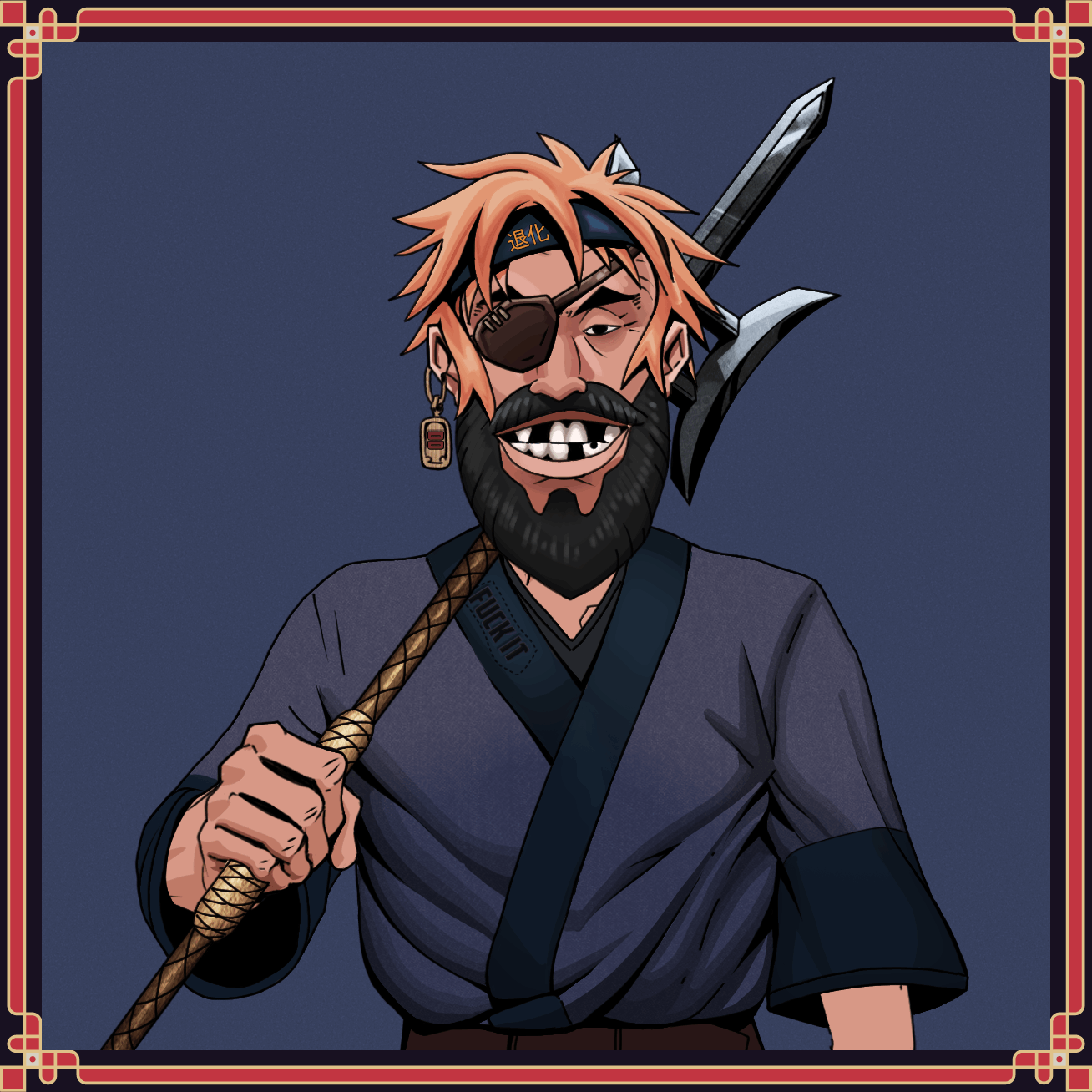
Igor The Veteran
They call him Igor The Veteran, and no one asks how he earned it; the room simply goes quiet when he sets down his cup. His integrity was intact until the afternoon he stopped to talk with Haru on the beach, and by the time the tide came back in he had aped his savings into whatever the boy was hawking and rugged himself in a single lazy conversation. Now he plans to open his own dojo, a place of order and honor, though the plans keep dissolving into cheap weed and cheaper bets before the first wall goes up. He tried once to draw up the founding scrolls at dawn, sober and straight-backed, and by noon he had wagered the ink on a dice throw and lost. The vets still nod to him, still fall silent, and he lets them believe the dojo will be real one day.
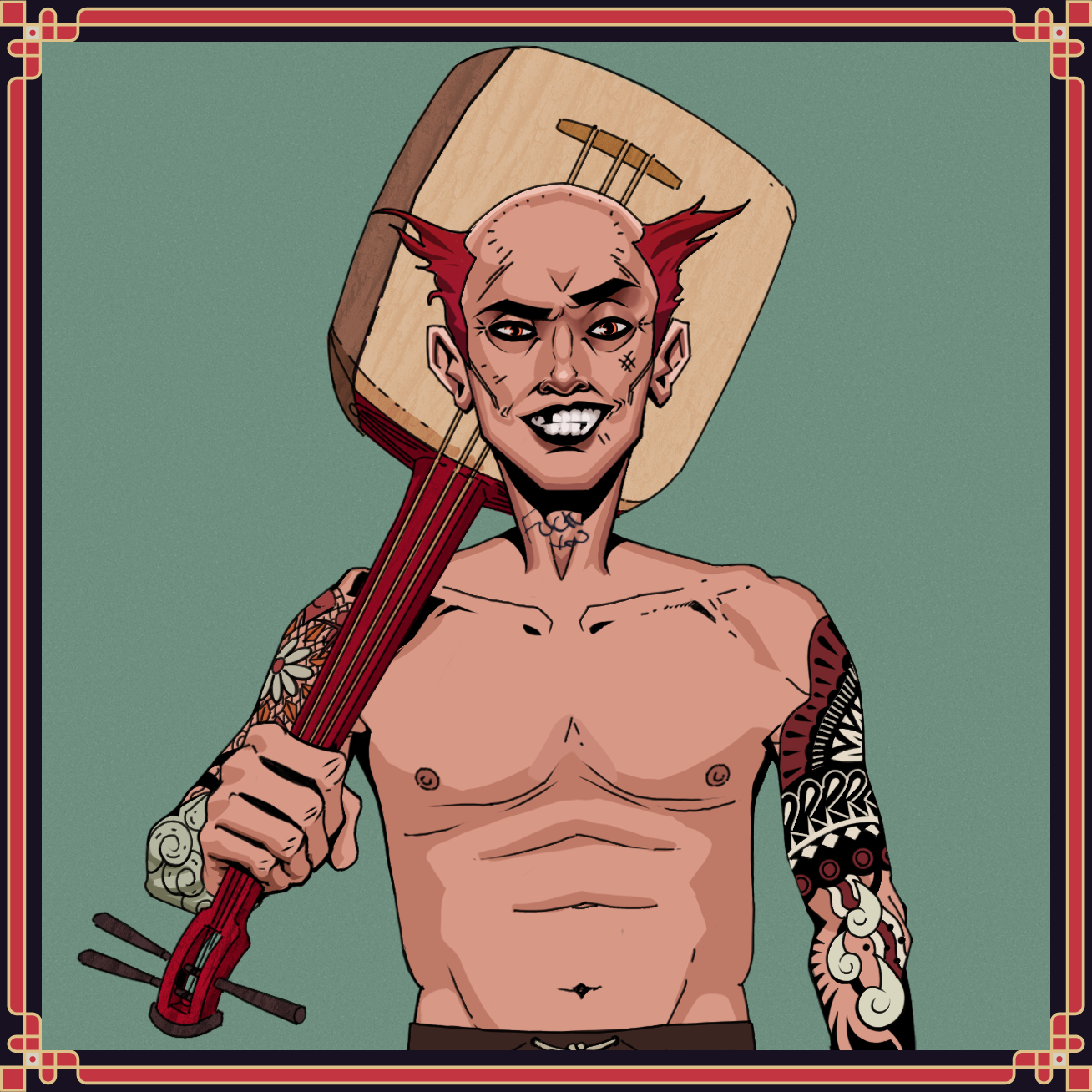
Junichiro
As the eldest son, Junichiro had trained his whole life to notice everything, to measure a man's honor by the tremor in his hands and the length of his shadow, and he took great pride in missing nothing. Yet there he stood before the shoji doors, laughing at some stupid joke with Haru, when a nimble hand slipped every last coin from his sash and vanished into the evening crowd. He never felt it happen, and when he finally noticed the lightness at his waist he was mortified beyond measure, though he would sooner rug himself than admit it. So he lifted his chin, declared the loss a lesson in vigilance he had generously chosen to learn, and announced he could not be more pleased with himself. Only Haru saw the way his jaw clenched, the way the first son always judged himself hardest of all.
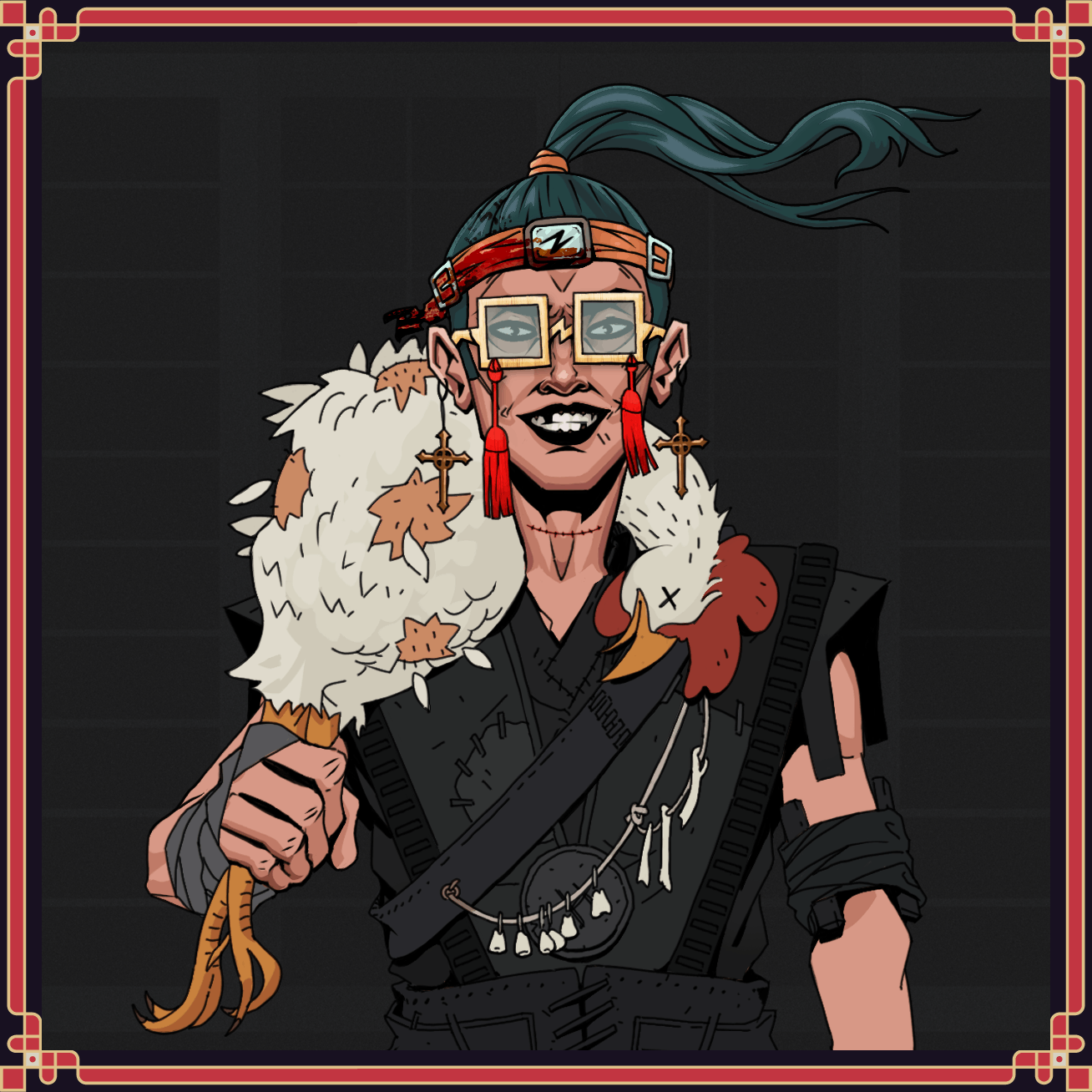
Junichiro Reborn
They say Junichiro Reborn died once already, in the smoky back rooms of a gambling house where he dressed as a woman to fleece drunk lords out of their coin, and somewhere between the losing hand and the shame he lost his integrity along with his last ryo. He drew the short blade to commit seppuku, sat down proper, breathed the old samurai breath, and then, in that unsettling calm of his, simply changed his mind and decided dying was too permanent a floor to sell at. Now he walks around introducing himself as a man who has already killed himself once, which makes every threat sound like a punchline and every punchline sound like a threat. He still tries to reclaim the discipline, sitting in meditation each dawn, and he still folds by noon into another game he swears he can beat this time. The reborn man laughs at his own myth because he knows the joke better than anyone: he came back different, but he came back exactly the same.
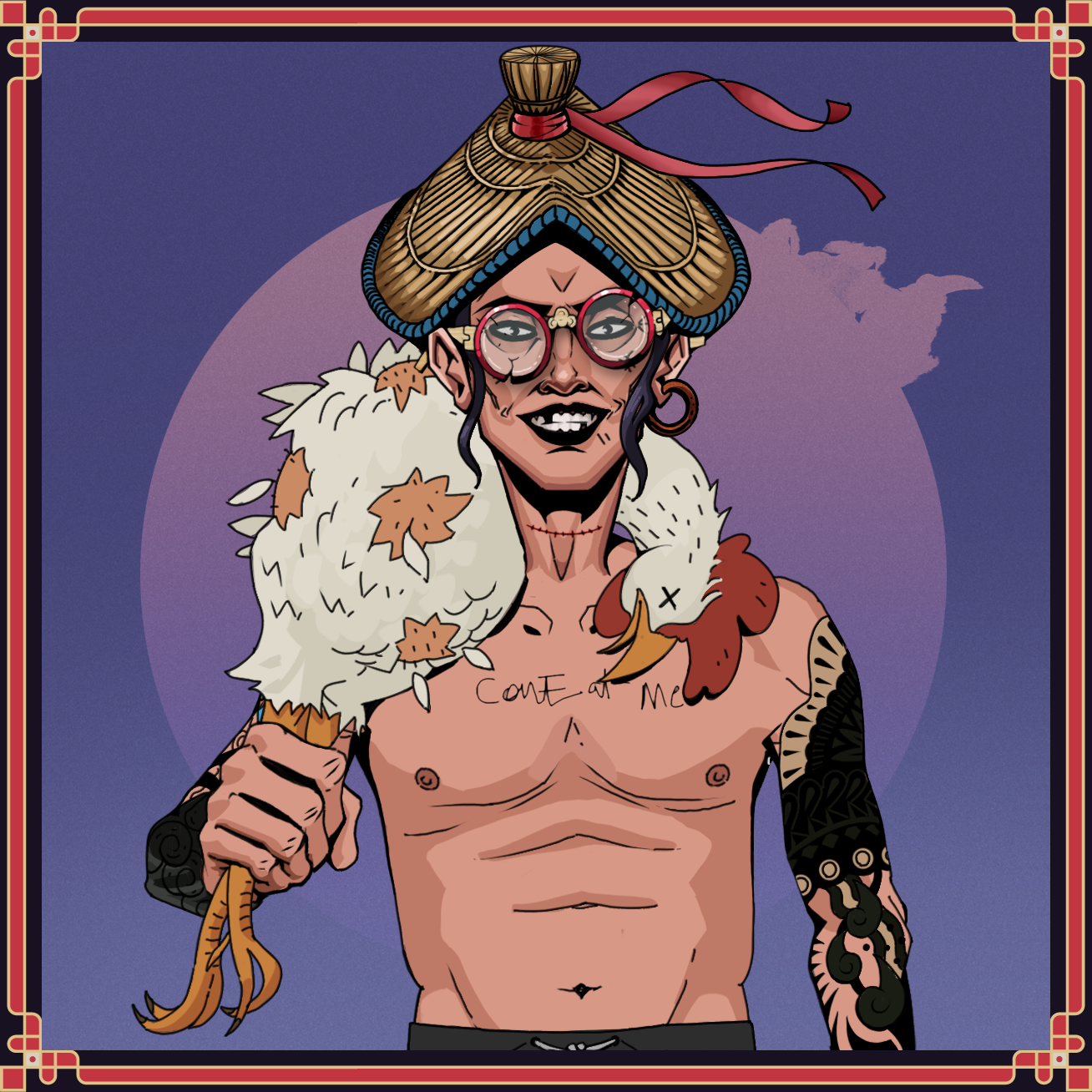
Junichiro Reborn
On a misty morning outside the walls of Sekigahara, Junichiro killed a man without breaking eye contact with Oleg, and something in him thrilled at the quiet of it, the way the fog swallowed the sound. He tells the story now like it happened to someone else, someone he used to be, someone he buried and dug back up for the punchline. These days he apes into hands he should fold and calls it discipline, insisting that a man who has already died once cannot really lose. He keeps a wooden practice sword by the door and swears he will drill at dawn, but dawn keeps finding him at the tables instead, grinning like the joke is on all of them. The old Junichiro would have been ashamed; the reborn one just orders another round and waits to feel that quiet again.
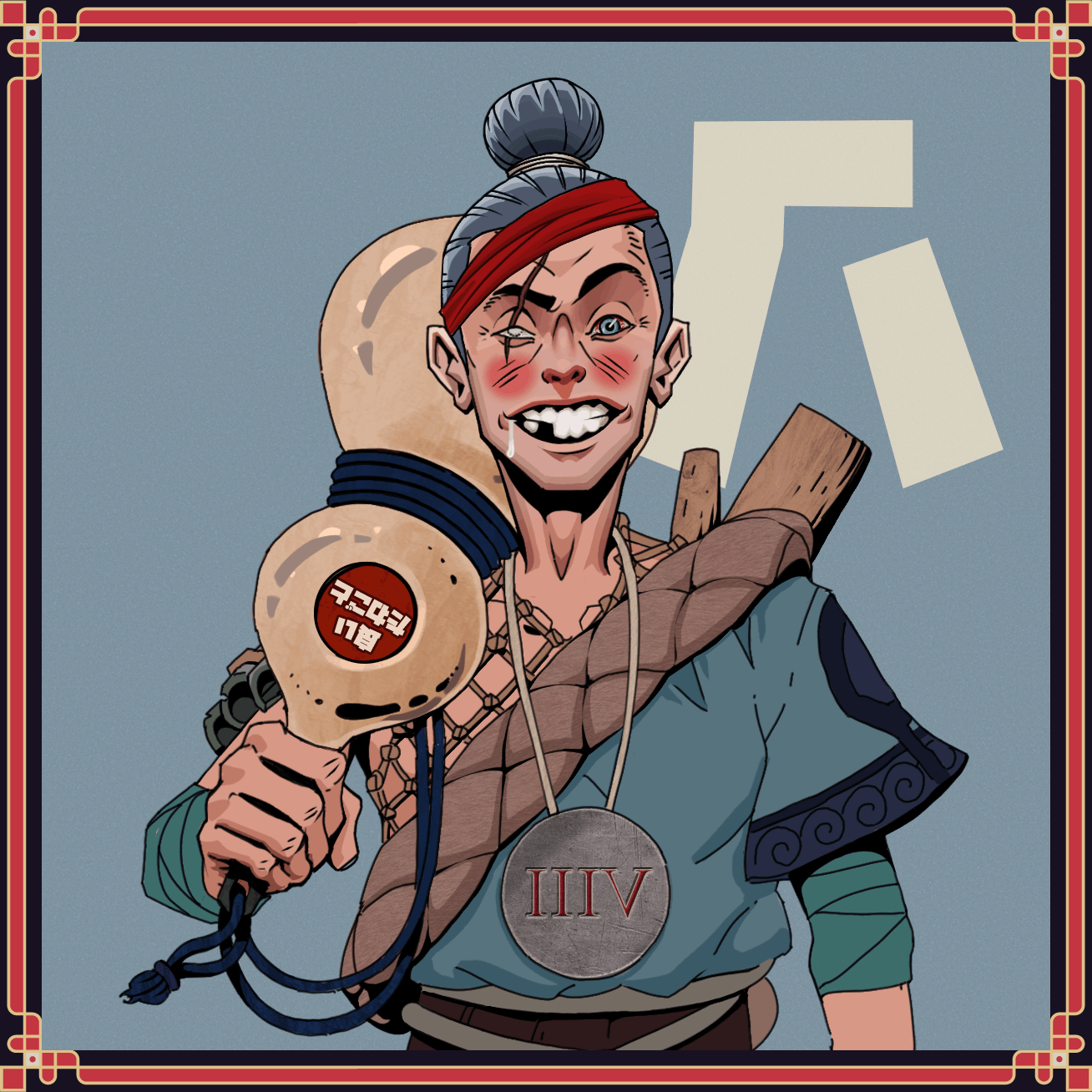
Legless Tom
Long before he was a category of misfortune spoken about in hushed tones across every teahouse, Legless Tom had been a sword arm without equal, all the way down to feet that had once carried him through three campaigns. Then the wars dried up, the discipline curdled into vice, and one grey morning The English Pilot found him sprawled stoned, drunk, and gloriously naked on Degens path, cackling at a sky that owed him nothing. A friendship was forged on the spot, mostly because Tom could not stand up to leave, and honestly neither of them tried very hard to fix that. He swears each dawn he will meditate, sober up, and reclaim the warrior he was, then reaches for the gourd and the weed instead and loses that fight before he has even risen. From the waist up he remains an unstoppable, grinning menace, which he insists is more than enough dojo for one degen.
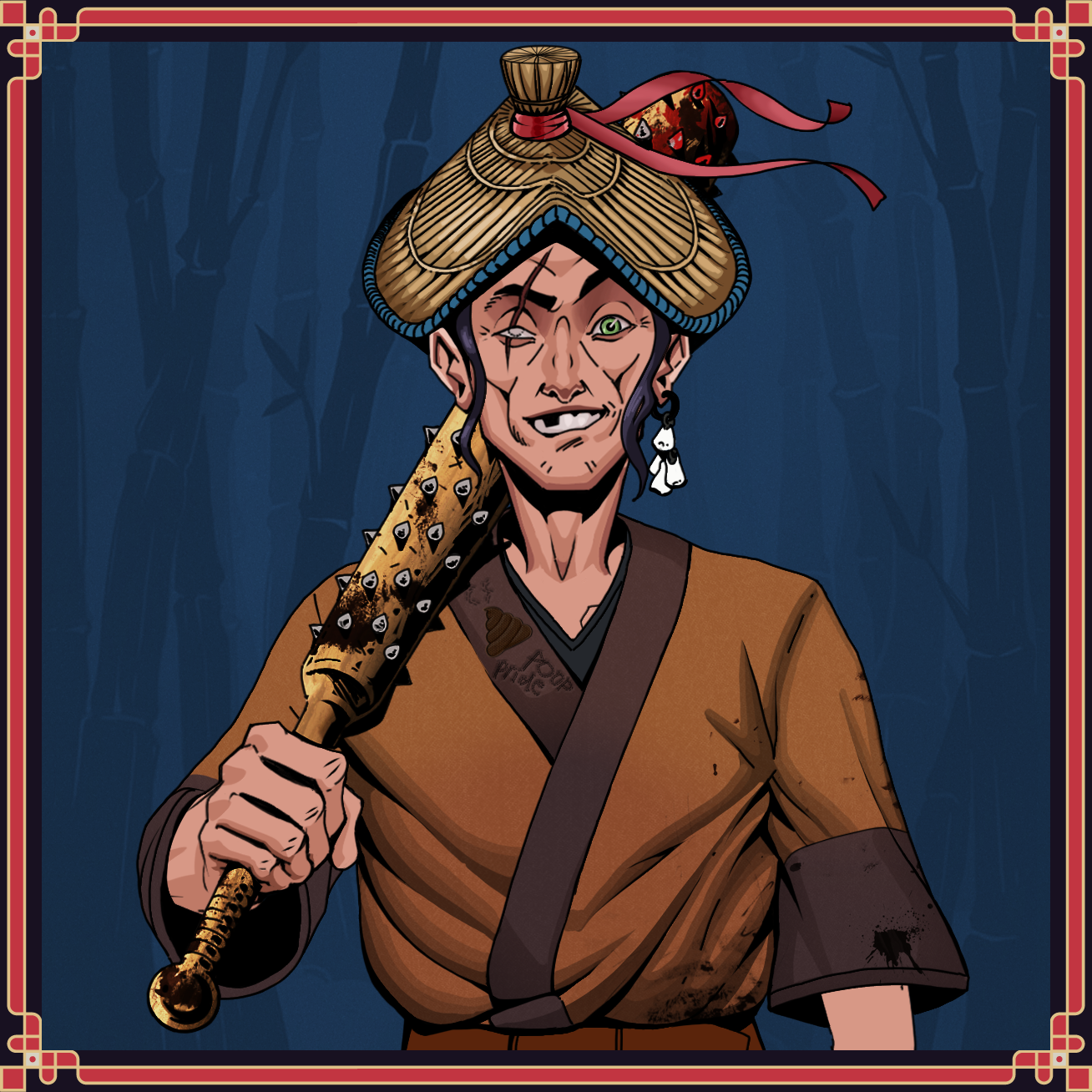
One-Eyed Itsuki
One-Eyed Itsuki lost his honor at the Edo palace the day he yanked out his own teeth in front of the shogun's court, and to this day nobody can say why, least of all him. He tells the tale slow, with a gap-toothed grin, insisting the missing eye and the missing molars taught him to see the half of the world worth watching. Since then he has aped into every low den from the gambling tables to the weed haze of the back alleys, always promising himself this is the round where he reclaims the discipline the war once gave him. He sits at the dojo each dawn to meditate, and each dawn he is asleep by the second breath, drooling through the hole where his pride used to be. "Half a mouth, half an eye, twice the clarity," he mutters, which fools no one and comforts him greatly.
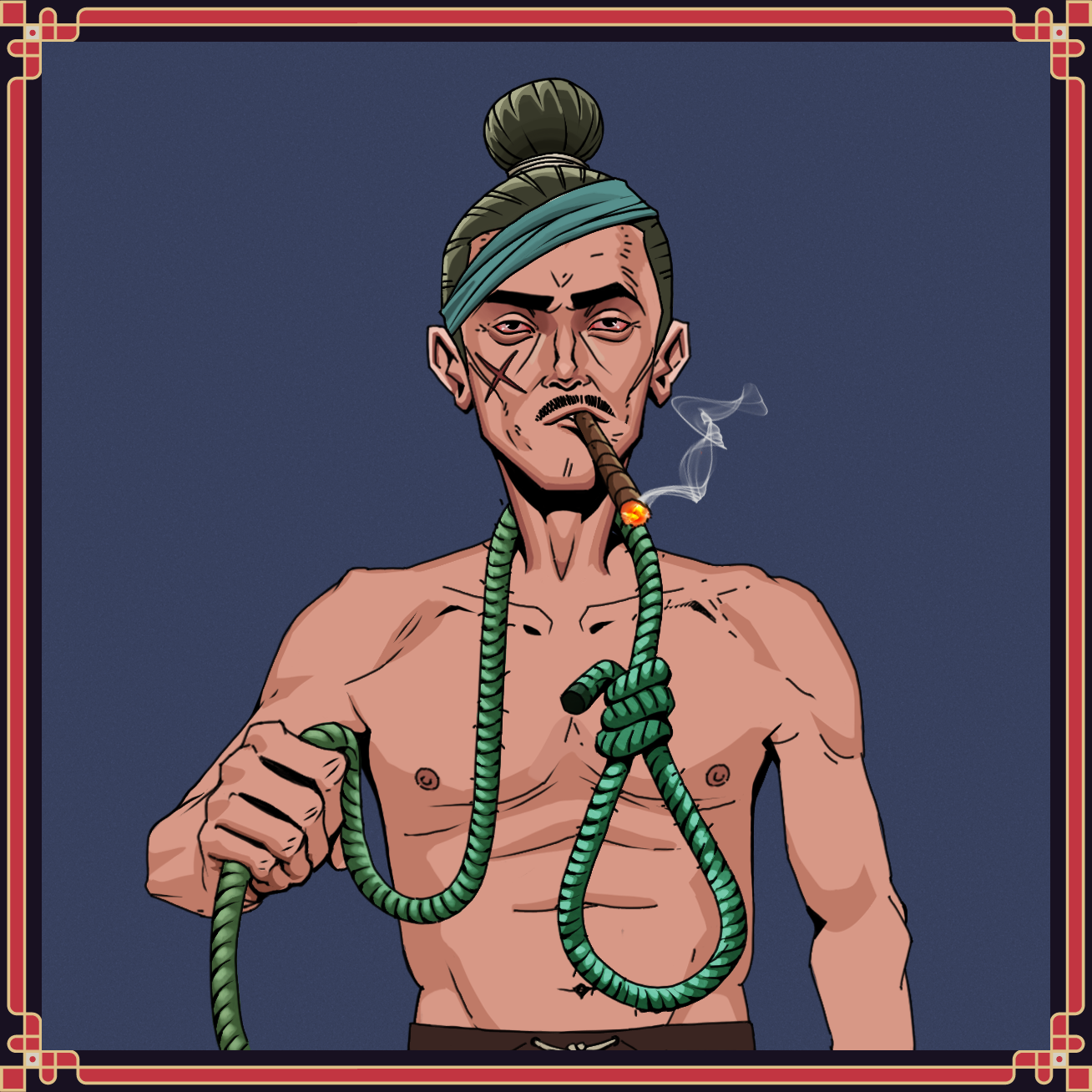
Raikou The Stoner
On a misty morning above the valley, Raikou set down his blade, exhaled a long slow cloud, and betrayed the master who had trained him since boyhood, and in that instant, he swears, he became enlightened. He does not talk about which master, or which mountain, only that the fog parted like a chart before a pump and he simply understood everything, man. His discipline is legendary in reverse: he moves slow as drifting weed haze until the exact heartbeat when he moves like lightning, and by then it is already over. Every so often he vows to reclaim the honor he traded away, sits perfectly still to meditate, and wakes up four hours later having aped his entire bankroll into some floor that already rugged. He regrets nothing, and offers only this: the path is the path, degen, and the path was on sale.
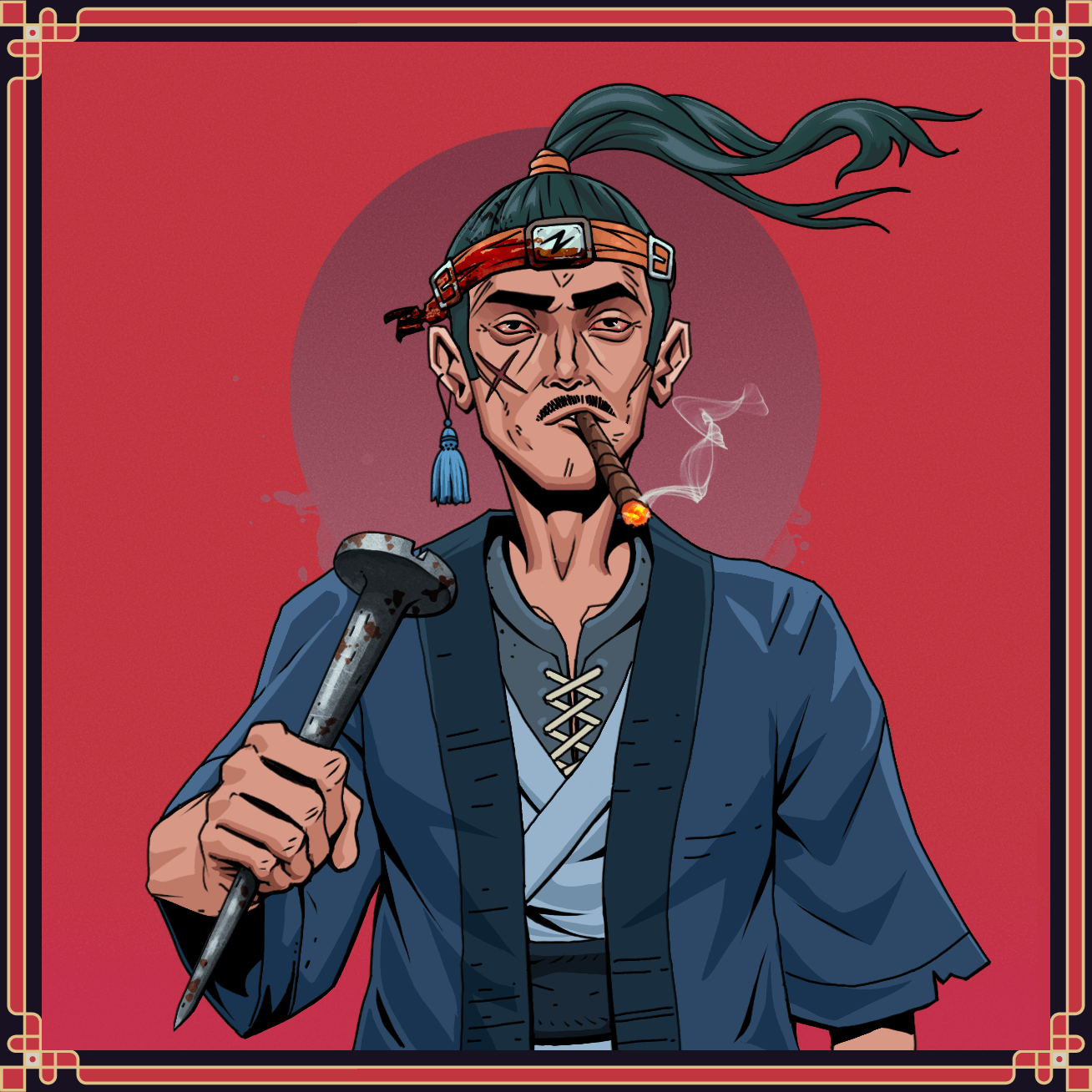
Raikou The Stoner
Raikou once moved like a thunderclap wrapped in silence, a swordsman whose blade knew the shape of the wind before the wind did. Then, in a haze that smelled suspiciously of weed and bad decisions, he tried to blackmail his own dojo brother in the latrines, and somewhere between the leverage and the laughter his katana snapped clean against the wall. He tells everyone it was a spiritual lesson about attachment, that the steel had simply reached enlightenment before he did, but the truth is he cannot forget the incident and it floats behind his eyes like smoke that won't clear. Every morning he vows to rebuild his discipline, and every morning he aped into another blunt and another dice roll instead, whispering that the path finds you when you stop chasing the floor. Slow, slow, slow he drifts, then lightning quick he trips over the ghost of that broken blade all over again.
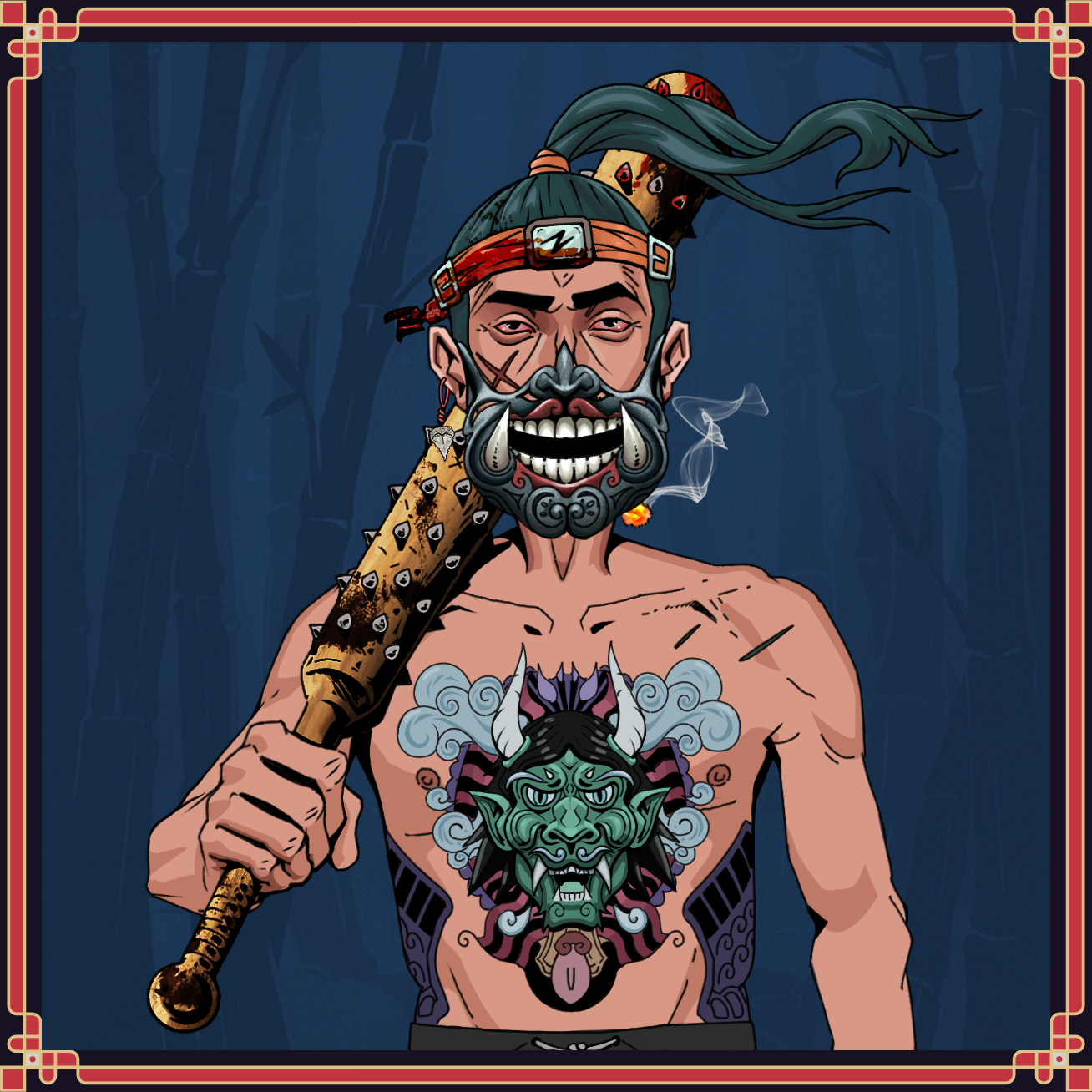
Raikou The Stoner
They say Raikou once stood among the sharpest blades in the province, back when honor still meant something and his hands never shook. Then came the night at the local yakiniku, where between the grill smoke and one too many rounds he drifted off into a lazy daydream of glory that never came, and by the time he blinked back to earth his respectability had quietly rugged him. He tells everyone he is chasing enlightenment now, moving slow like a cloud until, allegedly, he strikes like lightning, but mostly he just apes into another bag of weed and mutters about the discipline he keeps meaning to reclaim tomorrow. He has not forgiven himself for that daydream, and no, brother, he never will. Somewhere under all that haze the samurai is still awake, floor-bound and stubborn, waiting for a strike that keeps arriving one heartbeat too late.
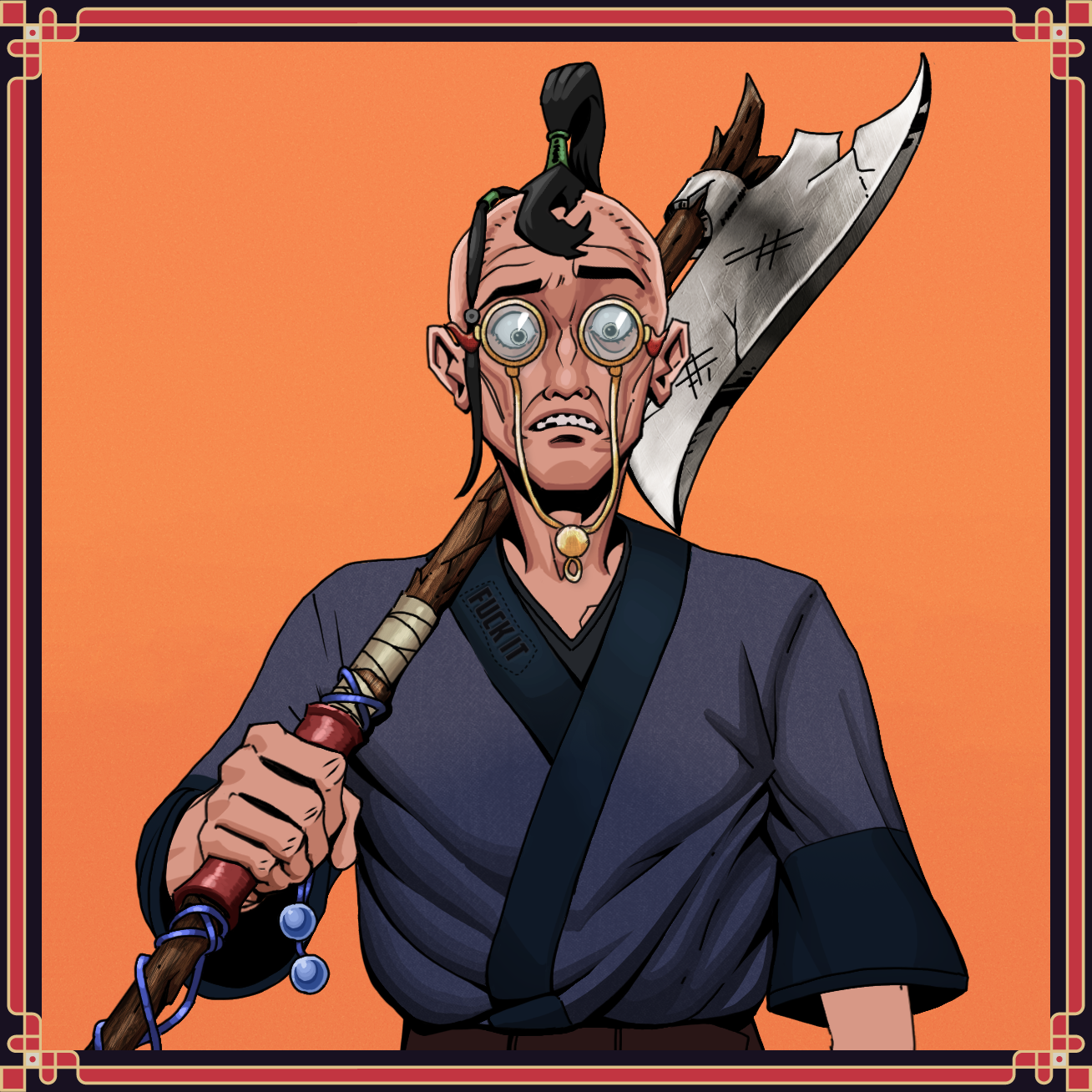
Shitless Botan
Botan once owned three estates and a warhorse named after a general he had personally embarrassed, then he sat down in the dirt one afternoon, thought at length about women, and stood up owning nothing at all. He does not flinch at this; he never flinches at anything, which is precisely why the other degens keep him at the far end of the bench where he calmly says the things nobody else dares. Now he is writing the Degen Handbook, a scripture composed mostly of warnings he ignored and losses he narrates as if reading someone else's obituary. He does attempt discipline, sometimes, sitting cross-legged at dawn to meditate on his ruin, but the meditation always drifts back to the dirt, the women, and the exact moment the floor fell out from under his life. The manuscript grows fatter than his fortune ever was, and he keeps writing, unbothered, a man with no fear left and nothing that fear could have saved.
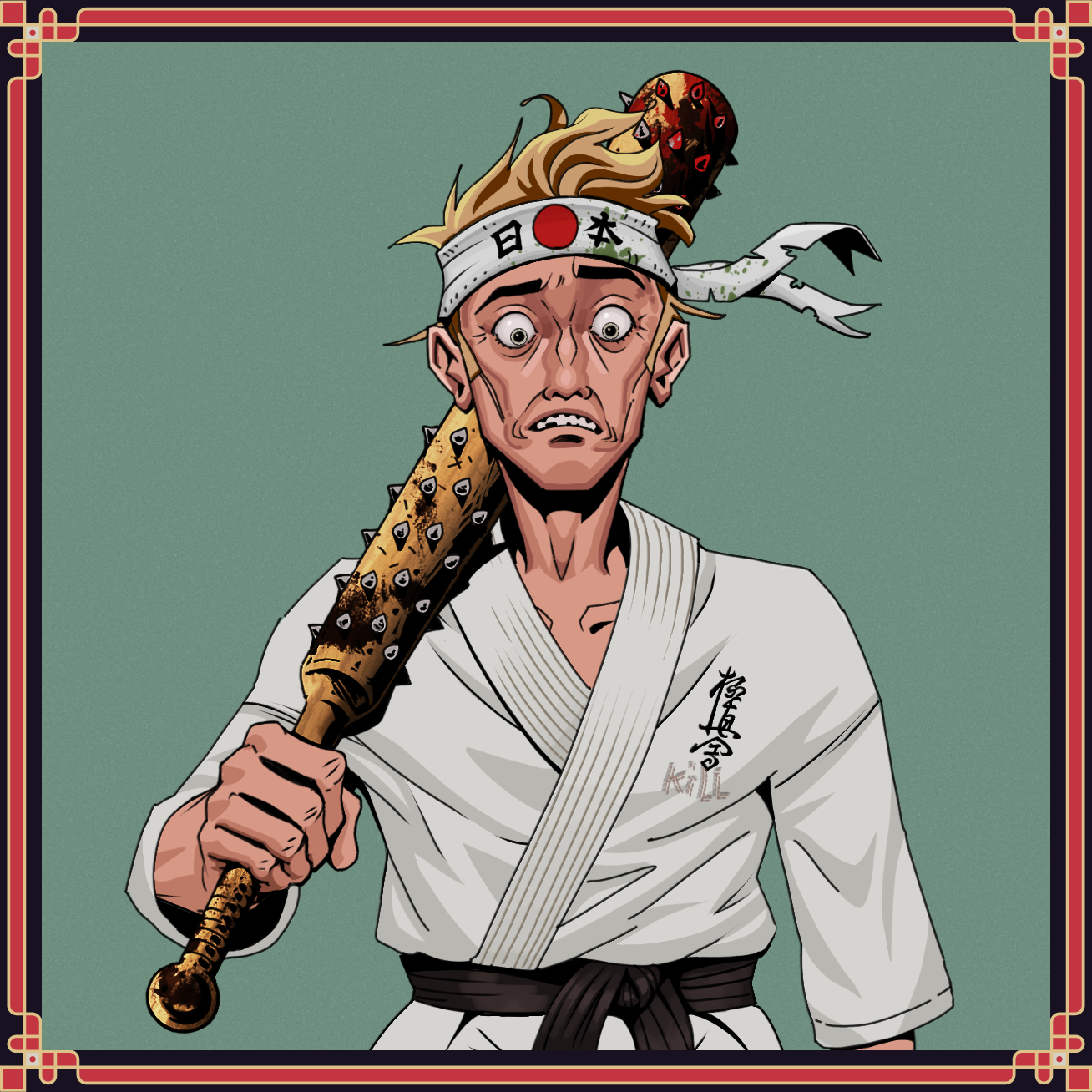
Shitless Botan
The noodle house went quiet the day Shitless Botan stood on a stool and screamed his master plan at a table of ninjas who had only come for broth. He was not afraid of them, was not afraid of anything really, having long ago misplaced the part of himself that flinches, somewhere between his last honorable duel and his first losing hand of dice. The plan itself was flawless in his own gallows-calm telling, though nobody could recall a single detail of it afterward, only that he had said the unsayable and slurped his noodles through the ensuing silence. These days he wanders the tables asking anyone with two coins and one opinion for advice about his future, because a man who fears nothing still needs somebody to tell him which way is up. He keeps swearing he will train again tomorrow, keeps waking up on the floor of the same noodle house, and keeps grinning like the joke is on everyone but him.
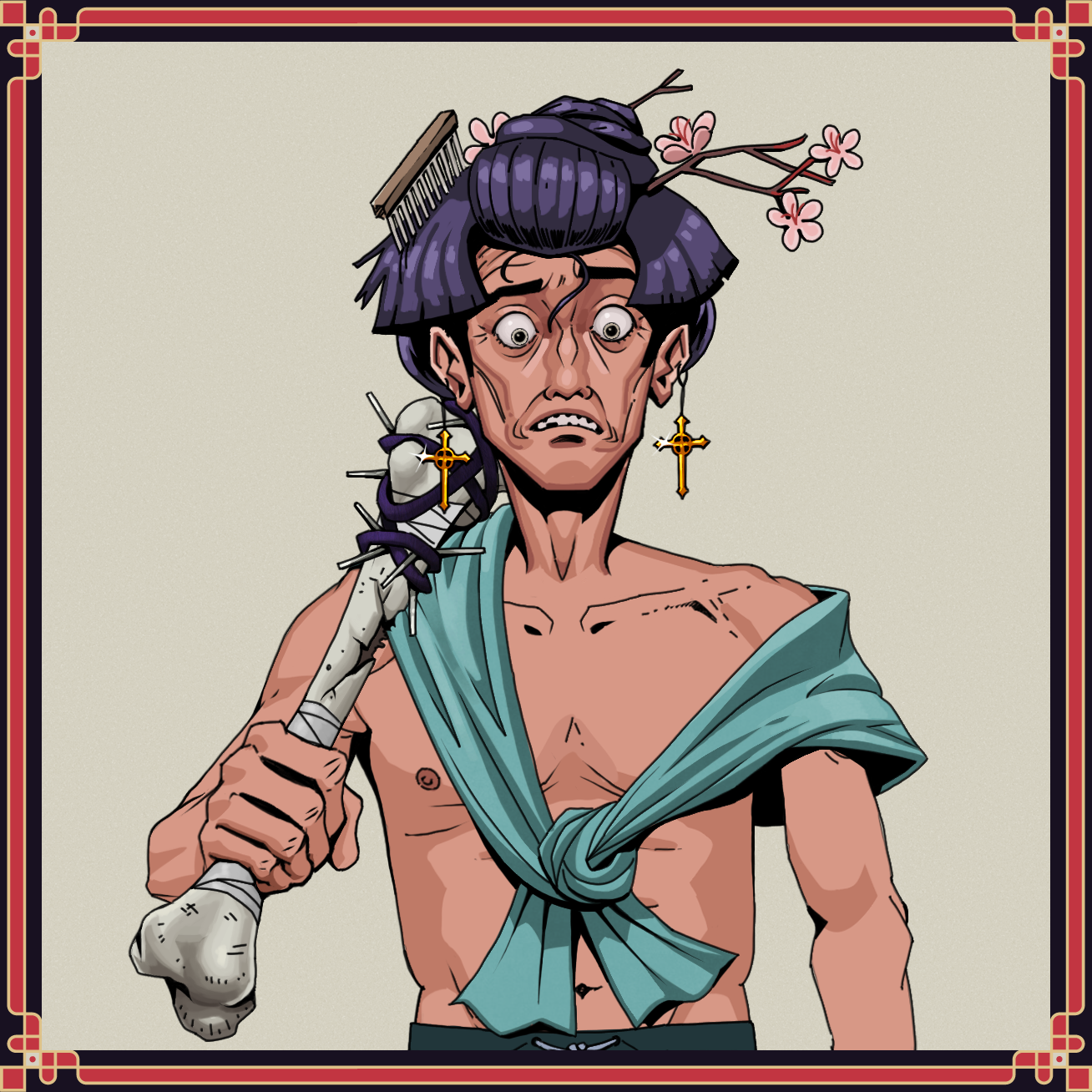
Shitless Botan
At Mount Koriyoka he chased his mistress up the frozen switchbacks with the flat calm of a man who had misplaced his capacity for fear somewhere on an old battlefield, and by the time he caught her he had somehow strengthened his status rather than ruined it, which surprised everyone but him. Botan says the unsayable at every table, announces his worst intentions like weather reports, and watches other degens flinch while he stays perfectly still. He tried, once, to sit in meditation and reclaim the stillness a samurai is supposed to earn instead of steal, but he lasted four breaths before wandering off to ape into a bet no reasonable man would touch. Now he lounges at the Dojo with his blade oiled and his losses unmourned, wondering, in that flat gallows voice, what could have been if he had ever once been afraid to lose it.
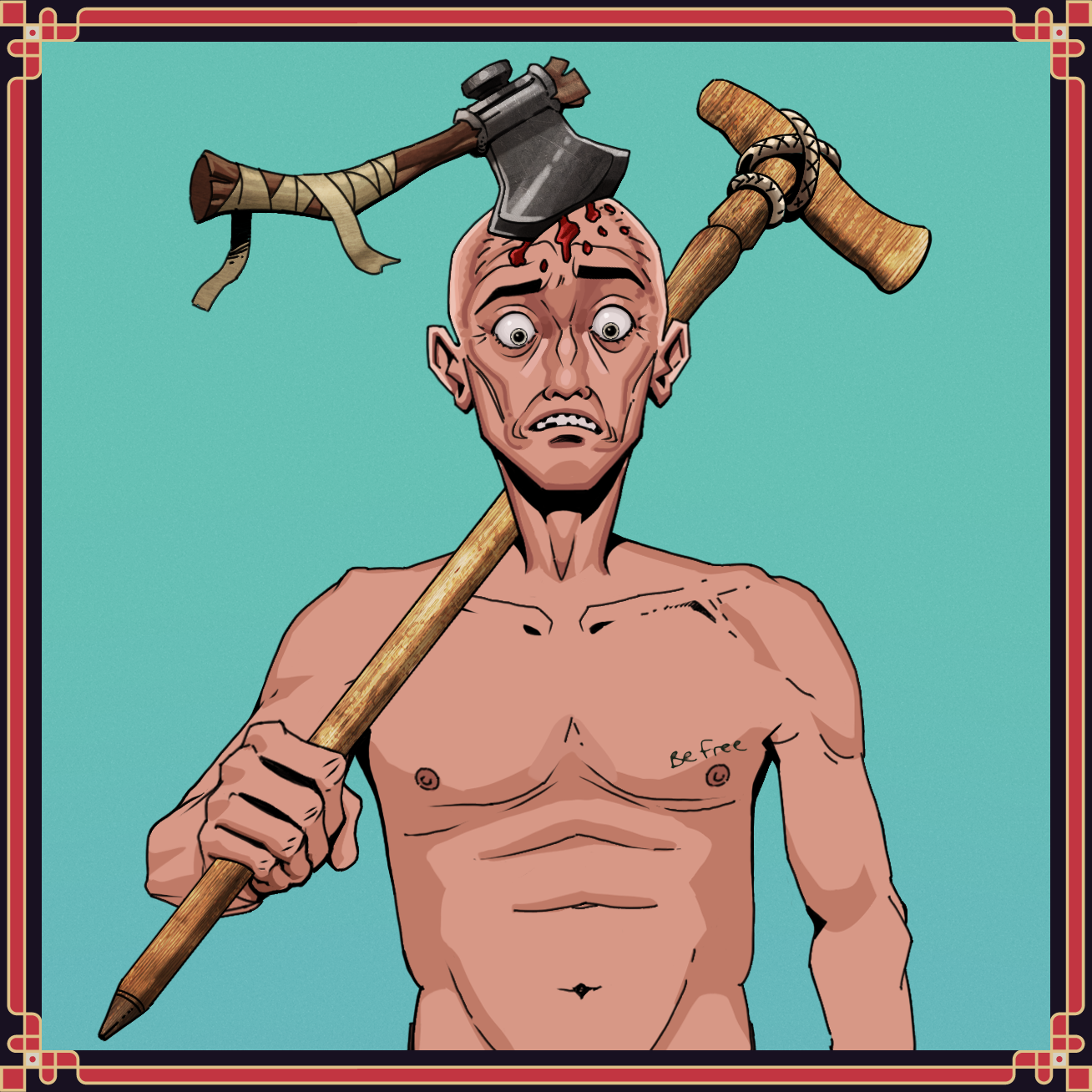
Shitless Botan
It was in the steaming waters of the onsen, deep into a fistful of mushrooms, that Botan watched his own fear dissolve like foam off the surface, and he has never once gone looking for it since. Some men chase enlightenment for forty years and find nothing; Botan found his in a single afternoon and spends every day thereafter reliving that exact moment, narrating the unsayable to anyone within earshot with the calm of a man who has already seen his own death and found it boring. He tells himself he trains to reclaim the samurai steadiness of his youth, then loses that fight the instant the water gets warm and the visions return. Once he cut down men without blinking; now he stares down a bad hand at the tables and simply does not flinch, because flinching left him along with the fear. What remains is a fighter who cannot be rattled, cannot be surprised, and cannot, for the life of him, remember why discipline mattered in the first place.
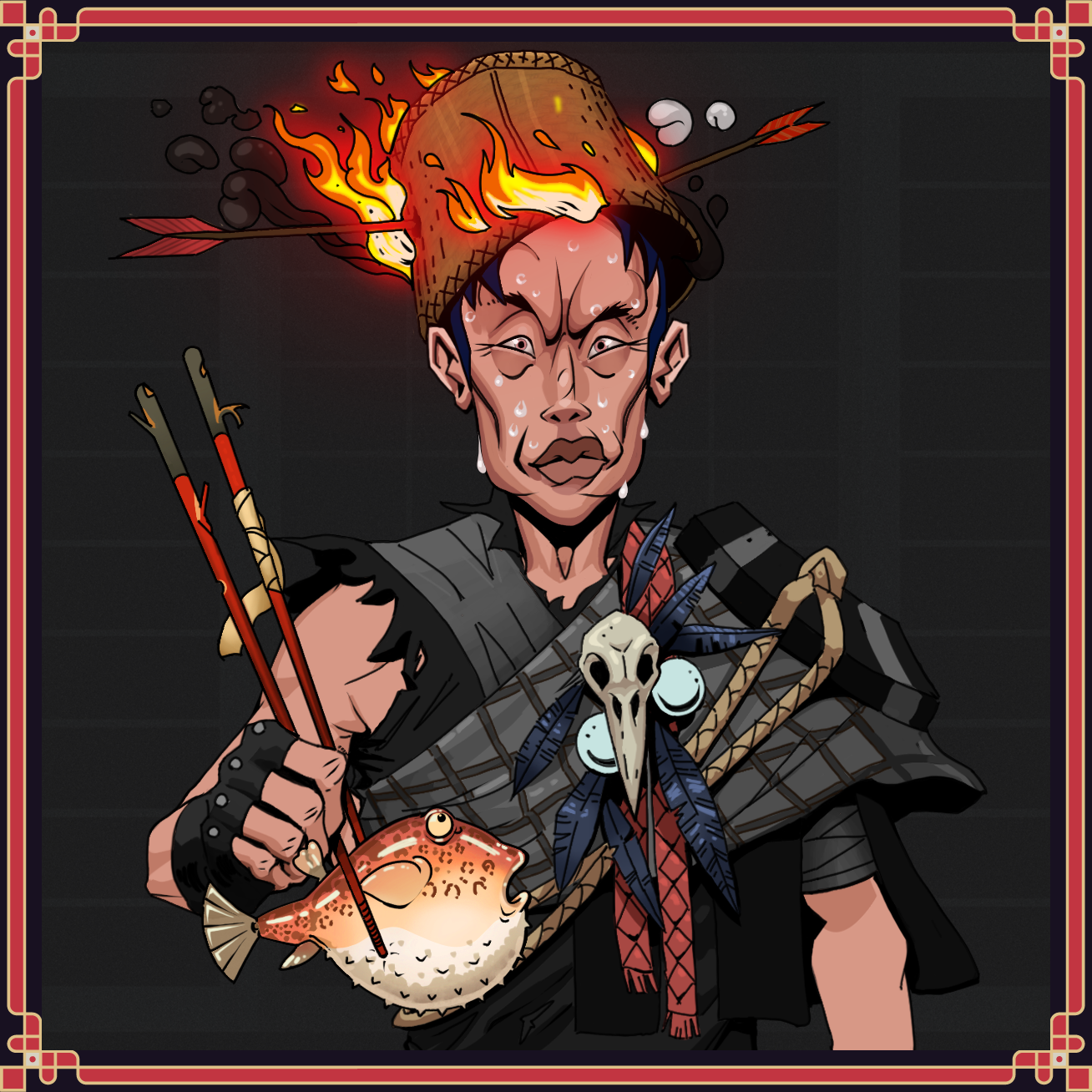
Stresshead Rin
Once, Rin was the sentry who never blinked, the samurai who packed three spare blades because two felt reckless, and now that vigilance has nowhere to go but inward. It all curdled the day he stopped to talk with The Old Dragon on Degens Path, a conversation from which he swears he caught a disease, and he relives that moment every single day, cross-checking every cough against a scroll of imagined symptoms. He tells himself he will reclaim his old discipline tomorrow, right after he triple-checks the locks, sharpens the blades he already sharpened, and rewrites his will just in case, which somehow eats the whole day. The floor of his mind is a hospice for worst-case scenarios, and he tends each one like a garden. Some warriors ache for war; Rin aches for the calm of having something real to fear.
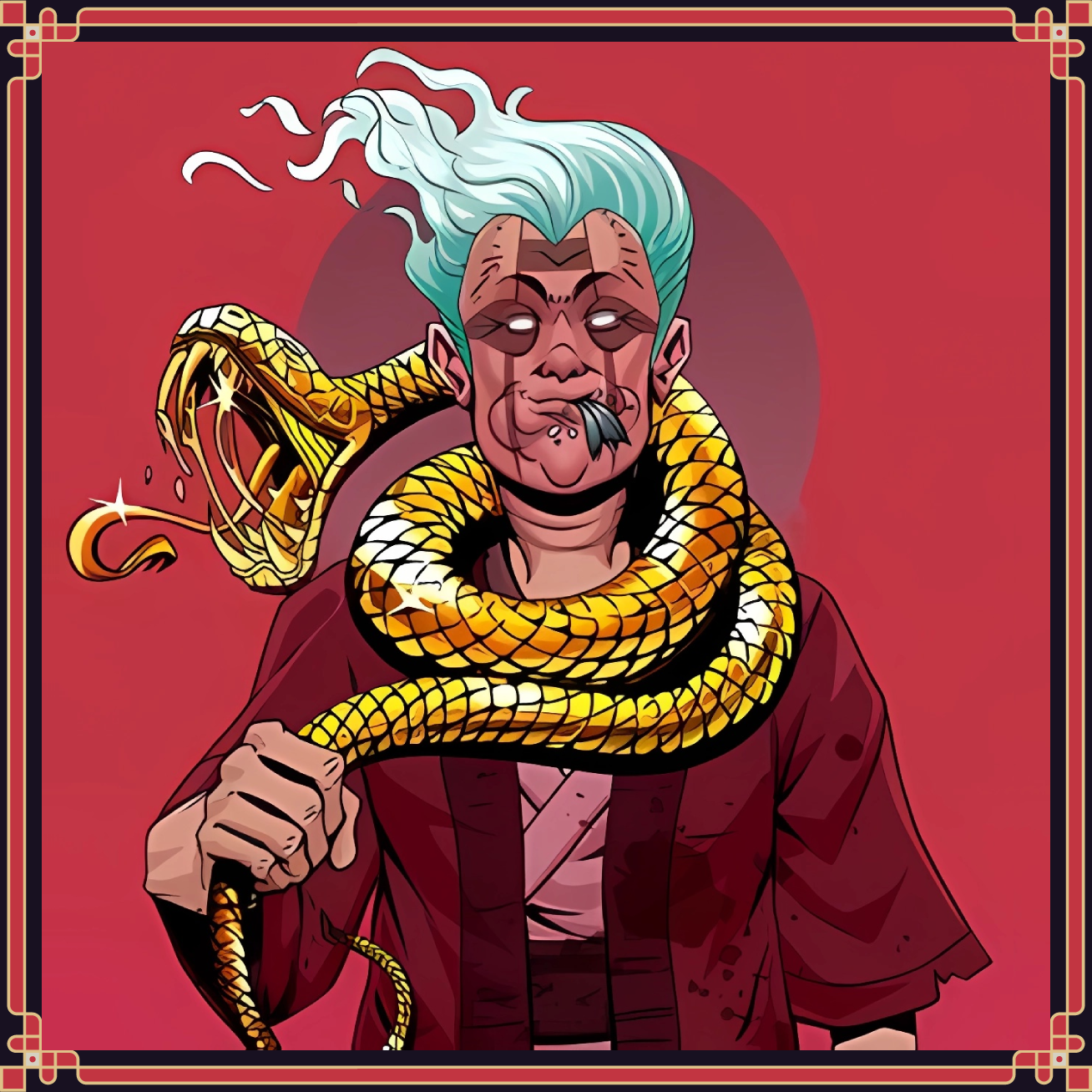
Timberwolf
Let the record show that Timberwolf is nothing like Fat Bob, no matter how many times the tavern regulars squint and ask if they are brothers, cousins, or the same disappointment twice. It was down in the dirt, sharing greasy ribs with BBQ Ben, that he misplaced his sandals entirely, and in that barefoot moment of shame he declared he would dedicate his whole life to Buddhism, achieve enlightenment, and finally outshine every shadow that came before him. He sat in meditation for one glorious afternoon before his knees screamed, a fresh bowl of weed appeared, and Ben asked if he wanted to gamble away his begging bowl. The old samurai in him whispered of stillness and discipline; the rest of him aped straight back into the mud, chanting sutras between mouthfuls of pork. He swears the barefoot enlightenment is coming any day now, and it will be entirely his own, thank you very much.
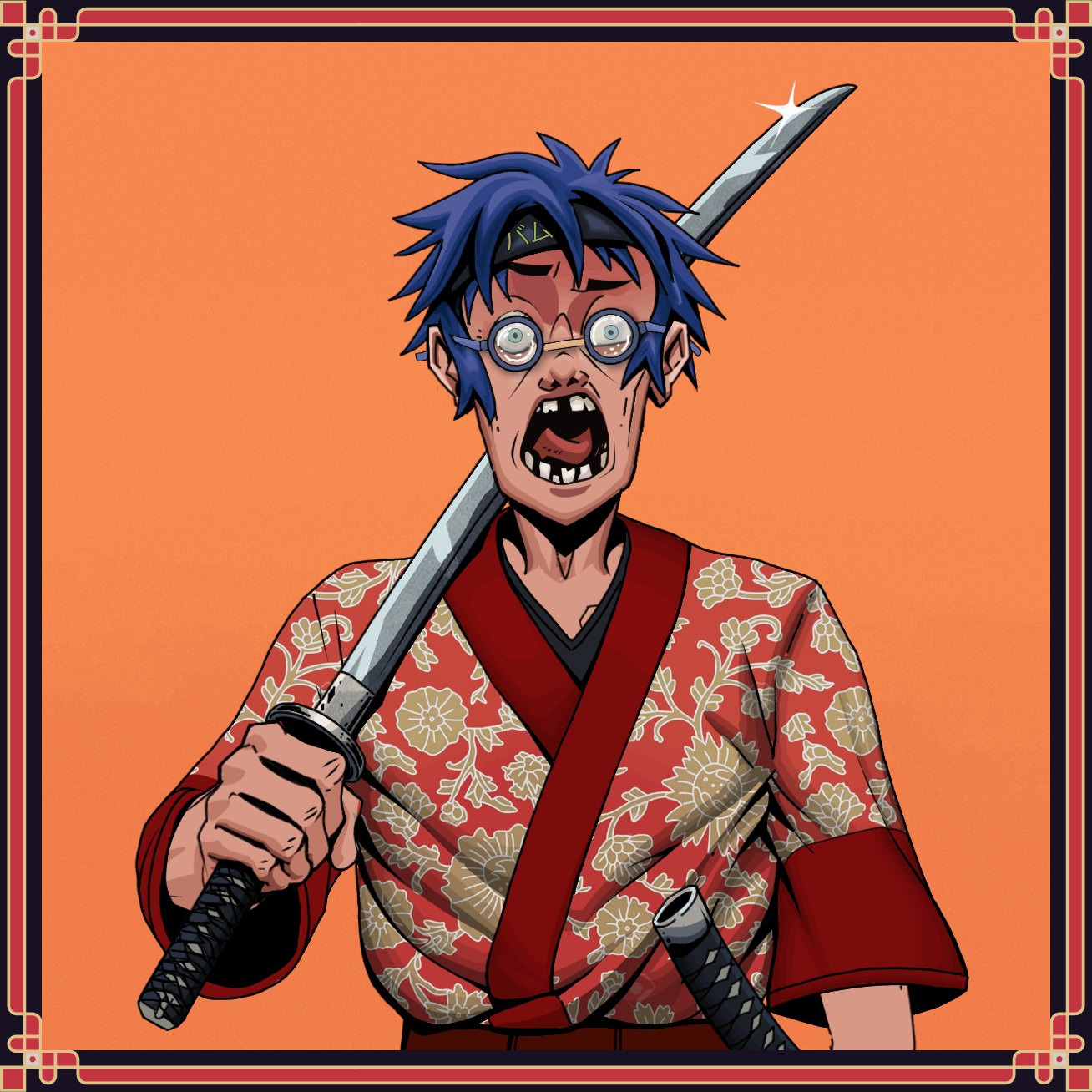
Tokuda
At the Ushigome izakaya, Tokuda downed a bowl of mushrooms someone swore were medicinal and promptly declared himself the greatest swordsman the province had ever birthed, shouting his war-cry at a paper lantern he mistook for an oncoming general. He charged. The lantern won, and so did the floor, and so did the three patrons he attempted to duel while apologizing to each of them mid-swing. "I HAVE CHOSEN TO FORGET THIS," he still bellows to anyone who brings it up, which is his way of admitting he remembers every excruciating second. Somewhere beneath the noise is a man who once meditated before a blade at dawn, and Tokuda keeps yelling loud enough to drown out how badly he misses him.
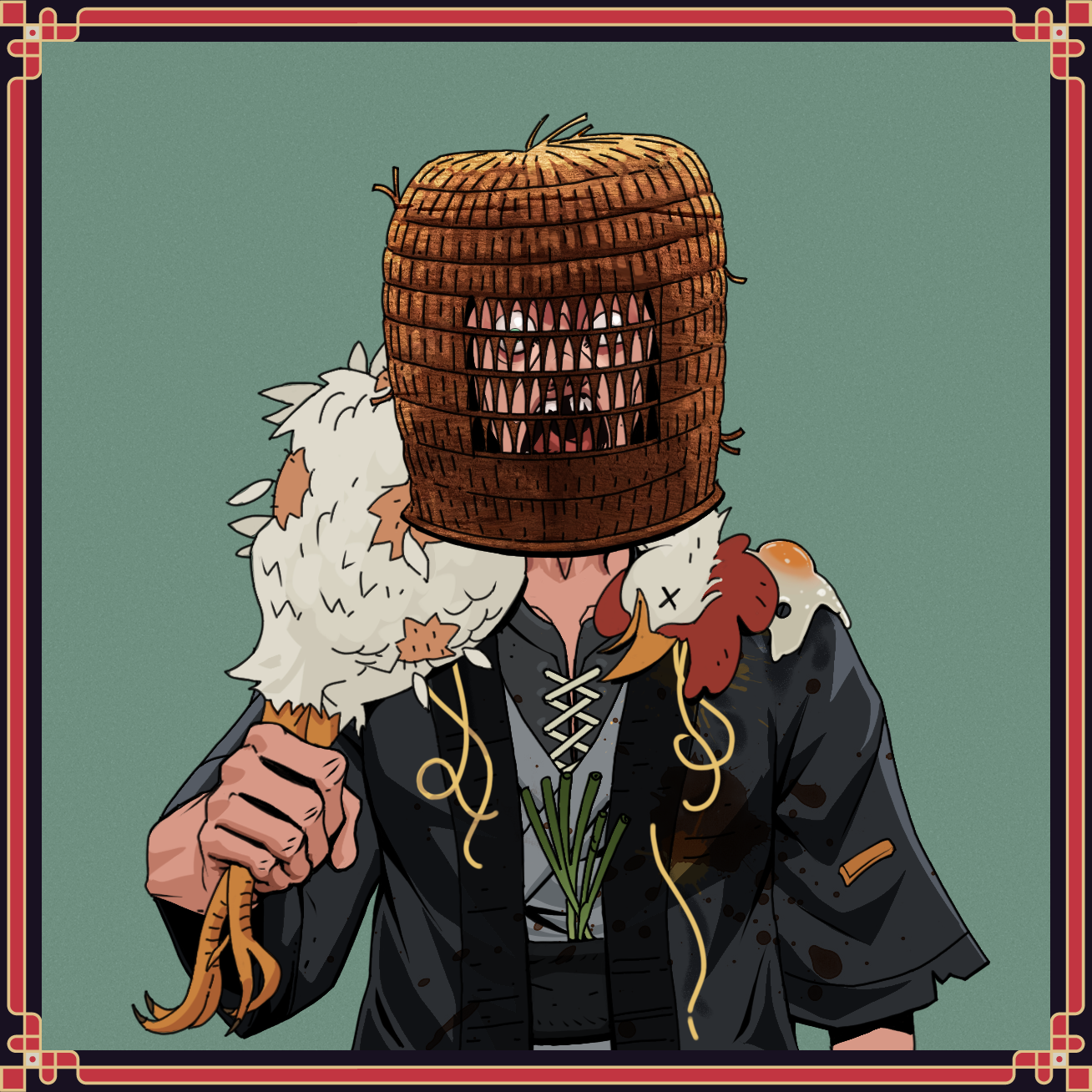
Tokuda
On a high moon evening, deep in the itch for a proper duel, Tokuda went hunting for The Kingpin and instead found a monkey, which he stabbed with the full battle-cry of a man who has nowhere left to aim it. "THAT COUNTS AS TRAINING!" he bellowed to nobody, the echo dying somewhere over the empty hills while the monkey filed a grievance he would never read. Once he had answered to a lord and a code; now he answers only to the crooked voice in his skull that keeps promising the next fight will fix him. He swears he is reclaiming discipline, and to prove it he is writing the Degen Handbook, though every chapter so far is just the word "AGAIN" scrawled in shaky ink over a spilled cup. He will not go quiet, he will not floor his own legend, and he absolutely will not admit that the monkey may have won.
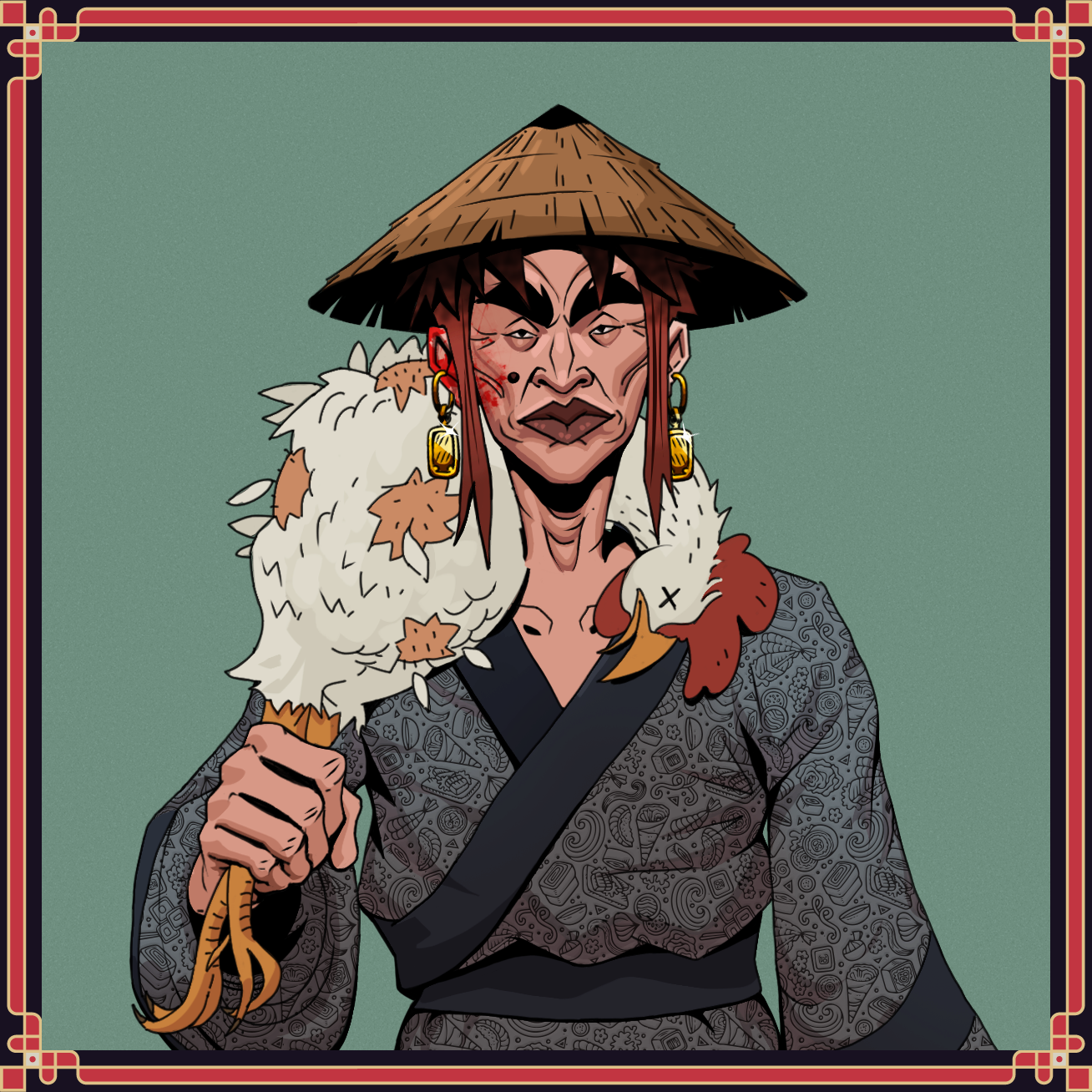
Young Yuji
Yuji was too young when the wars sputtered out, robbed of the glory his blade was forged to chase, so now he prowls the alleys around the Dojo at sleepless hours hunting coin like it might bring the battle back. It was there he befriended a pack of degens who taught him to ape into things a disciplined boy never should, and he took to it with the recklessness of someone convinced the world still owed him a fight. He tells himself every dawn that he'll walk the honest path again, then rugs his own resolve by noon chasing the next promised jackpot. The worst part, the part that gnaws at him when the sake runs dry, is that he still hasn't told his family, still lets them believe the boy they raised is out there earning honor instead of losing his floor to strangers. Somewhere behind the swagger sits a kid who just wanted to matter, still waiting for a war that already left without him.
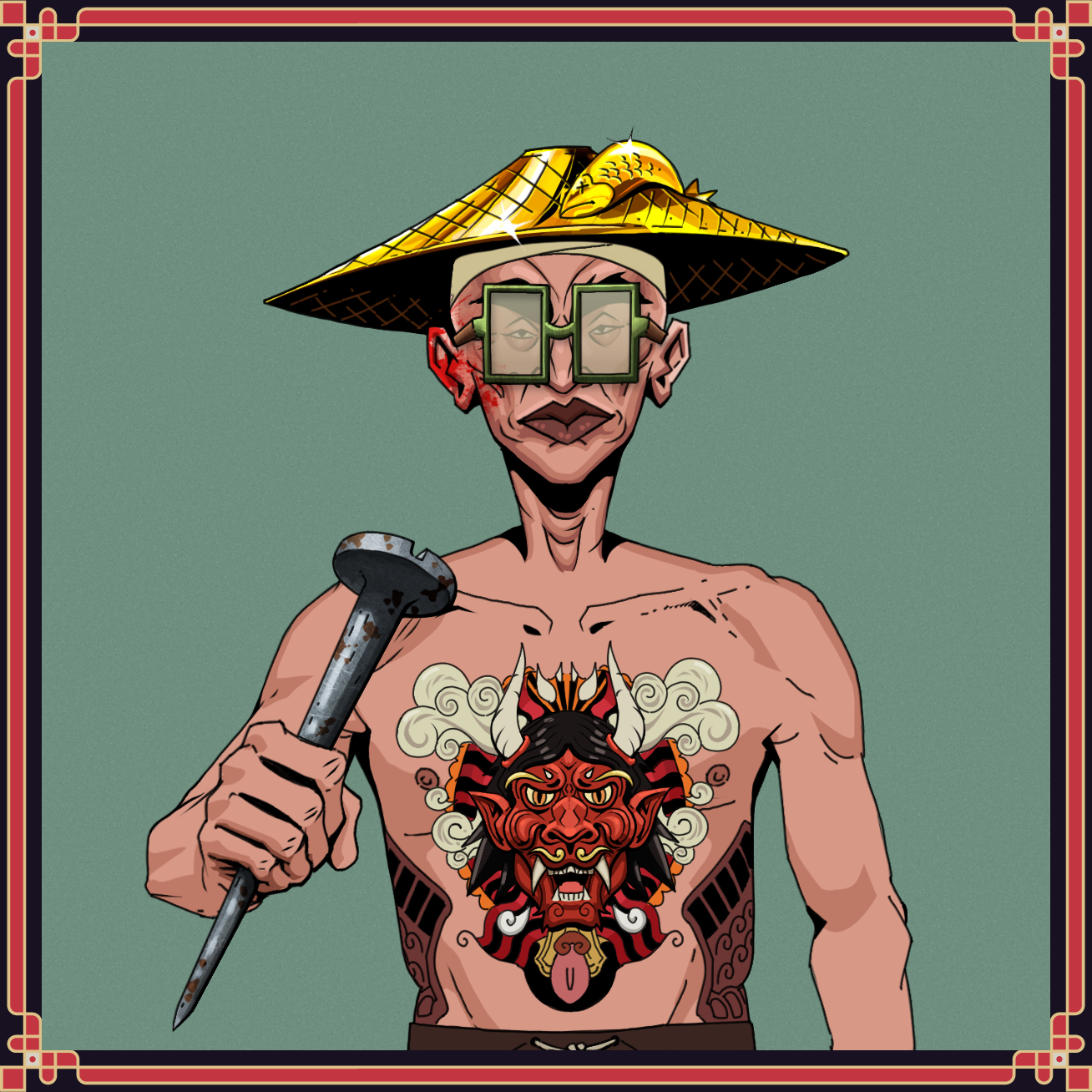
Young Yuji
Young Yuji was born a season too late, sharpening his blade for a war that ended before he ever got to swing it, and the glory he trained his whole boyhood for simply packed up and left without him. So he chased the next best rush instead, running his mistress across the tatami mats of every teahouse that would still take his coin, and somewhere between the third bottle and the fourth he got too drunk to remember which one he was chasing. He tells himself the discipline is coming back any night now, that he will sleep and rise clean at dawn like the masters did, but he hasn't slept in a week and his hands still shake for a battle nobody's fighting. Every time he lays the sword across his knees to meditate, the room tilts and the mats rush up to meet him. The kid's still waiting for a fight that already went home.
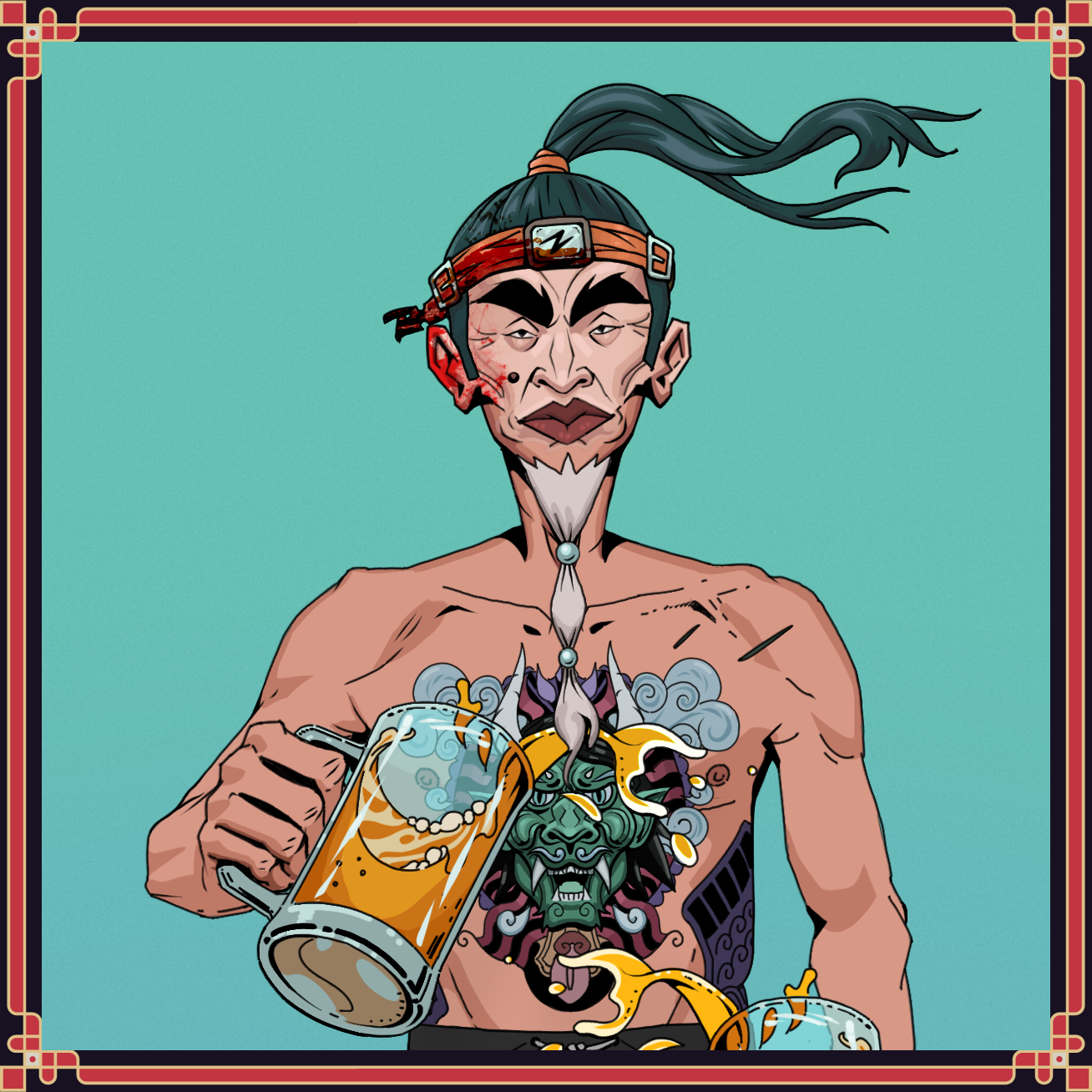
Yuji The Wise
Yuji The Wise once carried himself like a man whose sword arm was as certain as his ledger, but everything changed the day he stood laughing in the streets with Haru, doubled over at some joke he can no longer recall, and felt his nerve simply drift out of him like steam off a teacup. Being a scholar by temperament, he did not scream or brood; he began to narrate, filling notebook after notebook with observations of the degens around him, always noting with dry humor that the man best positioned to describe discipline was the one most spectacularly incapable of practicing it. Each dawn he vows to rise early, meditate, and reclaim the steadiness he lost, and each dawn he instead ends up chronicling why the plan fell apart before noon. Still, he looks forward to better days, and he writes that hope down too, because a chronicler must record even the things he suspects he will never quite achieve.
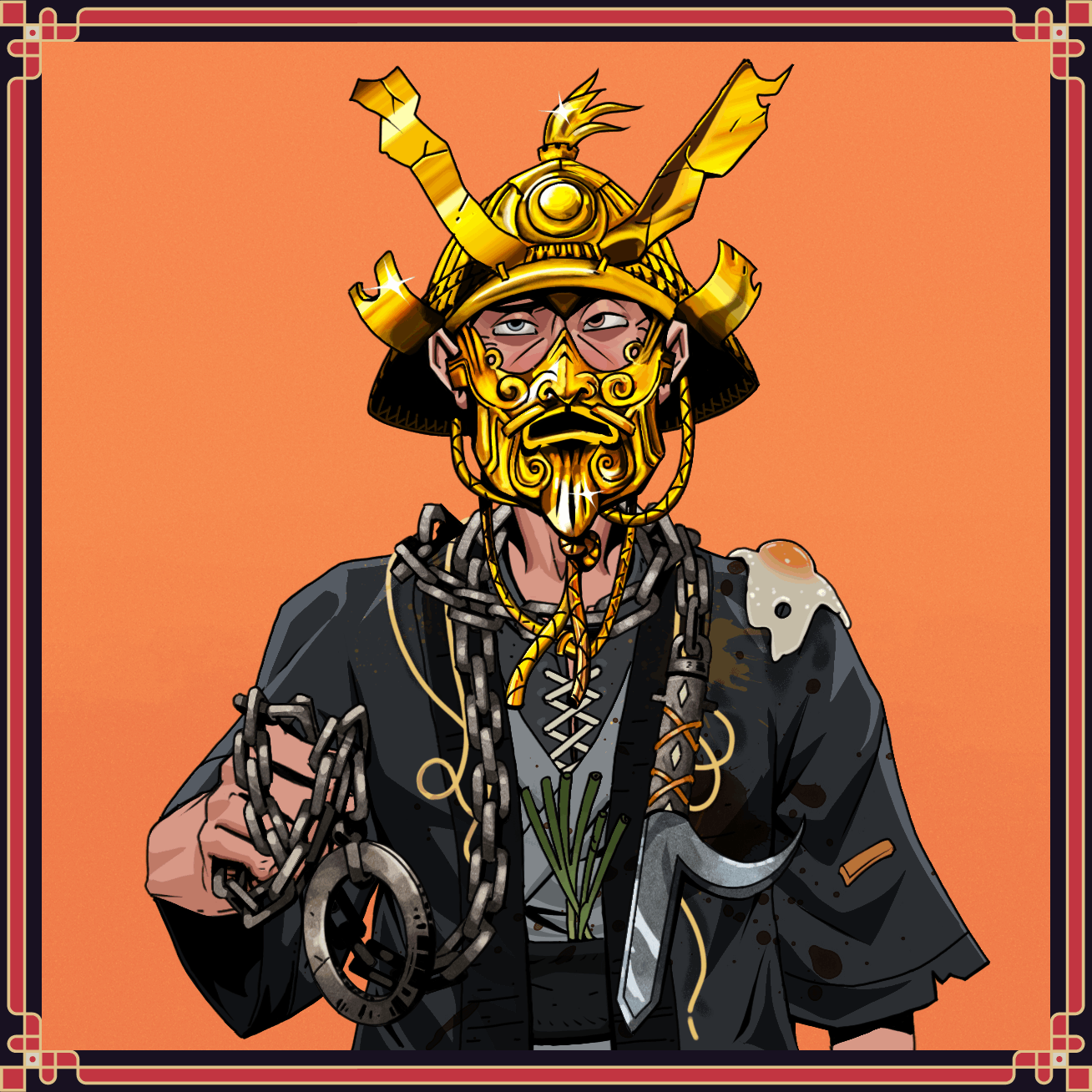
Yuuki
Yuuki had faced down cavalry charges at the foot of Mount Fuji without so much as blinking, so it surprised no one more than himself when his heart was undone not by Rin, whom he had been gamely flirting with, but by the pig that wandered between them. The courage that once held a shield wall now held a leash, and he carried that pig everywhere with the grave dignity of a man escorting royalty. He tells himself he will reclaim the old discipline any day now, right after he trains the pig to bow, a project that has cost him three months and considerable respect. His family still does not know, because every time he sits to write the letter home he loses his nerve entirely, a warrior felled by his own return address. Steady in battle, wobbly in love, he simply scratches the pig's ears and calls it a strategic retreat.